
Every emerging commercial corridor in Gurugram gets written about. The GCER vacancy problem, the Cyber City premium, the Noida Expressway opportunity, the upcoming Gurugram Metro effect on Sohna Road — these are the narratives that fill market reports and broker conversations.
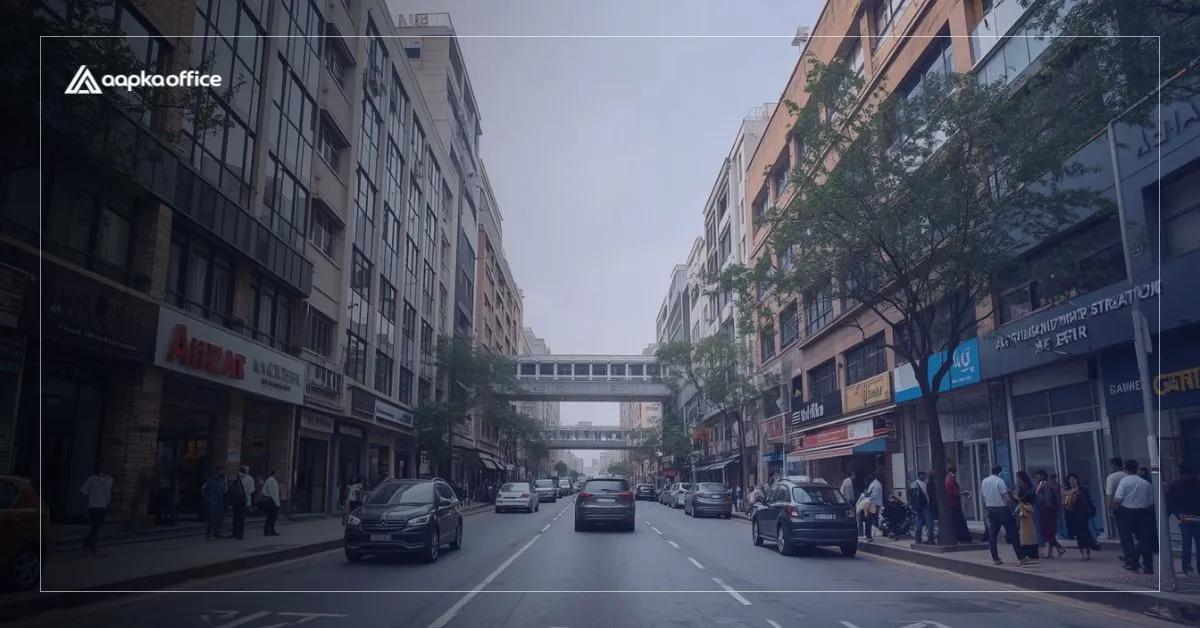
What almost no broker presents systematically is the case for the corridor that was once Gurugram’s most active commercial market and is now significantly undervalued relative to its fundamental characteristics: the MG Road belt, from Sikanderpur to Huda City Centre, including the immediate hinterland of Sectors 14 to 26.
This corridor is not neglected because it lacks merit. It is neglected because it is neither new nor fashionable — and in a commercial property market where brokers tend to recommend the newest corridors and the most marketed buildings, established-but-overlooked locations receive systematically less attention than their fundamentals warrant.
This case study builds the specific case for why the MG Road belt is Gurugram’s most undervalued commercial location for SMEs between 10 and 60 seats — examining the connectivity, the workforce catchment, the building stock, the rental economics, and the specific tenant profiles for whom this corridor delivers superior value compared to the alternatives they are being shown.
1. What the MG Road Belt Is — The Specific Geography
The corridor under analysis covers a specific geographic footprint:
The core: The commercial buildings within 600 metres of MG Road between Sikanderpur and the Iffco Chowk junction — approximately 2.5 km of prime commercial frontage and its immediate side-street hinterland.
The extended zone: The commercial development in DLF Phase 1 (Sector 26 and 27), Sector 14 main commercial strip, and the commercial buildings along Old Gurugram Road connecting these clusters.
The transit anchors: Sikanderpur Metro Station (Delhi Metro Yellow Line) and Huda City Centre Metro Station (Delhi Metro Yellow Line terminus), both on the corridor.
What the corridor contains:
A heterogeneous mix of commercial buildings — from 15 to 20 year old Grade B mid-rise developments to a handful of newer Grade A towers that were completed between 2016 and 2022. The older stock is significantly dominant — which is both the corridor’s primary perceived weakness and, as this case study argues, the source of its primary economic advantage for SMEs.
2. The Connectivity Case — What This Corridor’s Transit Access Actually Looks Like
The MG Road belt’s most underappreciated characteristic is the quality of its metro access.
The Yellow Line connection:
Sikanderpur station sits at the northern end of the corridor. Huda City Centre station sits at the southern end. A business located at any point on MG Road is within 600 metres of at least one Yellow Line station.
The Yellow Line provides:
- Direct service to Qutab Minar, Saket, and AIIMS in South Delhi — journey time from Sikanderpur to AIIMS: approximately 22 minutes
- Direct service to Hauz Khas, INA, and Dilli Haat
- Direct service to Rajiv Chowk (Connaught Place interchange) — approximately 38 minutes from Sikanderpur
- Interchange to Blue Line at Rajiv Chowk — enabling connections to Noida, East Delhi, and the northern Blue Line corridor
Compare this to the alternatives:
From Cyber City, the nearest Yellow Line station is approximately 2 km away (requiring the Rapid Metro connection to Millennium City Centre, then walking to MG Road, or using a feeder). The effective metro connectivity from Cyber City is lower than from the MG Road belt despite Cyber City’s position as Gurugram’s premium commercial address.
From GCER, the nearest metro station is typically 3 to 5 km — the corridor is car-dependent. A workforce that commutes by metro cannot reliably access most GCER buildings.
From Udyog Vihar, Sikanderpur is the closest metro station at 2 to 3 km — accessible but not walking-distance.
The workforce catchment implication:
The Yellow Line serves one of Delhi’s densest middle and upper-middle income residential belts: South Delhi (Saket, Hauz Khas, Vasant Vihar, GK II), New Delhi areas (Dilli Haat, INA, Central Secretariat), and Gurugram’s own residential spine (DLF City, Sushant Lok, Sector 14 to 22 residential). A business on MG Road can hire from this entire belt with manageable commute times.
For an SME that does not operate company buses — which describes most 10 to 60 seat businesses — metro access quality directly determines the quality and depth of the available workforce. The MG Road belt’s metro connectivity is superior to every other Gurugram commercial corridor except the immediate vicinity of Cyber City’s Rapid Metro stations.
3. The Client Accessibility Case
For many SMEs — particularly professional services firms, consulting practices, technology companies with enterprise clients, and financial services businesses — client accessibility is a significant factor in location choice. The office must be reachable for clients coming from across Delhi NCR.
The MG Road belt’s client accessibility:
A client travelling from South Delhi (AIIMS, Saket, Safdarjung): 22 to 30 minutes by metro, door-to-door. No driving required.
A client travelling from Connaught Place or central Delhi: 38 to 45 minutes by metro.
A client travelling from Noida (Sector 62): 45 to 55 minutes by metro via Rajiv Chowk.
A client travelling from Gurgaon residential (DLF City, Sushant Lok): 15 to 20 minutes by road.
Compare this to GCER:
A client from South Delhi reaching GCER: 40 to 70 minutes by road depending on traffic, no metro option. The Gurgaon rush hour makes this journey unreliable.
A client from Connaught Place: 55 to 90 minutes by road.
For SMEs whose clients are distributed across Delhi NCR — rather than concentrated in Gurugram’s technology park belt — MG Road’s accessibility from all directions is a genuine operational advantage that GCER and Udyog Vihar cannot match.
4. The Building Stock Reality — What Is Actually Available and at What Cost
The narrative about MG Road’s commercial buildings is typically “old Grade B stock that cannot compete with modern Grade A.” This is accurate as a description of the average — but it misrepresents the specific opportunity available in this corridor.
What the building stock actually looks like:
The MG Road belt has three distinct layers of commercial building quality:
Layer 1 — Genuine Grade B (buildings completed pre-2010):
15 to 20 year old mid-rise commercial buildings, 4 to 8 floors, individual or strata-owned landlords. These buildings have adequate specification for standard office use — central HVAC (though often older systems), basic security, basic common areas. They are not premium by modern standards.
Current asking rents: ₹55 to ₹80 per sq ft per month. Actual transacted rents: ₹48 to ₹70 per sq ft per month with negotiation.
Layer 2 — Upgraded Grade B+ (buildings completed 2010 to 2018 with subsequent renovation):
Mid-rise buildings that have been refurbished — improved common areas, upgraded HVAC, professional facility management. These buildings compete meaningfully with newer GCER Grade B stock on specification at significantly lower rents due to their age perception disadvantage.
Current asking rents: ₹70 to ₹95 per sq ft per month. Actual transacted rents: ₹62 to ₹82 per sq ft per month.
Layer 3 — Grade A and near-Grade A (2016 to 2022 completions):
A smaller number of newer buildings — 10 to 15 floors, institutional-quality fit-out, professional building management, BMS infrastructure. These buildings are genuinely Grade A in specification but are priced at a discount to Cyber City because the MG Road address does not carry the premium positioning of the Golf Course Road or Cyber City address.
Current asking rents: ₹88 to ₹115 per sq ft per month. Actual transacted rents: ₹78 to ₹100 per sq ft per month.
The vacancy position:
Across the three layers, the MG Road commercial belt runs at approximately 18 to 25% overall vacancy — with the Layer 1 buildings above 25% and the Layer 3 buildings at 12 to 18% vacancy. This vacancy level creates meaningful tenant leverage across all building types.
5. The SME Cost-Per-Seat Economics — The Specific Financial Case
The economic case for MG Road as an SME location becomes specific when compared to the alternatives on a per-seat basis.
The comparison: 30-person SME, 3,000 sq ft office, 3-year lease
Option A: Cyber City, Grade A managed office
Per-seat managed office cost in Cyber City: ₹12,000 to ₹16,000 per seat per month Monthly total cost (30 seats): ₹3,60,000 to ₹4,80,000 Security deposit (5 months): ₹18,00,000 to ₹24,00,000
Option B: GCER, Grade B conventional lease
Conventional lease: ₹70 per sq ft × 3,000 sq ft = ₹2,10,000/month CAM at ₹15/sq ft: ₹45,000/month Electricity (sub-metered): ₹40,000 to ₹60,000/month Total: ₹2,95,000 to ₹3,15,000/month Fit-out cost: ₹25 lakh to ₹40 lakh (bare shell) — significant upfront cost Security deposit (5 months): ₹10,50,000
Option C: MG Road belt, Grade B+ conventional lease
Conventional lease: ₹72 per sq ft × 3,000 sq ft = ₹2,16,000/month CAM at ₹14/sq ft: ₹42,000/month Electricity: ₹40,000 to ₹55,000/month Total: ₹2,98,000 to ₹3,13,000/month Fit-out cost: ₹20 lakh to ₹30 lakh (older buildings typically include basic fit-out or partial fit-out from previous tenant) Security deposit (5 months): ₹10,80,000
The headline finding:
The monthly occupancy cost between GCER Grade B and MG Road Grade B+ is essentially equivalent. But the MG Road location provides:
- Metro walkability that GCER does not
- Client accessibility from South Delhi and central Delhi that GCER cannot match by road in reasonable time
- A Gurugram address equivalent in professional standing to GCER for most client contexts
- Often lower fit-out cost due to availability of partially fitted or fully fitted former tenancies
Versus Cyber City managed office:
The saving from MG Road Grade B+ conventional lease versus Cyber City managed office is approximately ₹50,000 to ₹1,70,000 per month — ₹6 lakh to ₹20 lakh per year. For a 30-person SME, this is the equivalent of a senior engineer’s annual salary. Over a 3-year lease: ₹18 to ₹60 lakh.
6. The Workforce Quality Advantage — A Factor Most Brokers Do Not Quantify
The metro accessibility described in Section 2 has a specific financial implication that almost no broker presents to SME clients: it affects the cost of hiring.
The hiring cost calculation:
A professional who commutes from South Delhi (GK II, Saket, Hauz Khas) to a Cyber City office travels 30 to 50 minutes by Rapid Metro + walking. The same professional commuting to an MG Road office travels 20 to 25 minutes by Yellow Line. The difference is not dramatic — but it affects whether a candidate accepts a lower salary in exchange for the convenience of a shorter commute.
The difference is more pronounced for GCER. A South Delhi professional considering an GCER office with a 60 to 90 minute road commute (dependent on traffic) requires meaningfully higher compensation to accept the location disadvantage, or simply declines to consider jobs in that corridor. This is reflected in the talent market: GCER businesses report higher compensation pressure for South Delhi talent pools than businesses on MG Road report.
The quantified implication:
This is impossible to calculate precisely — it depends on the specific talent profile and the specific candidate. But if an SME avoids even one salary increment (₹1 to ₹2 lakh per year for a mid-level professional) because their location is more attractive to candidates, the cumulative effect over a 30-person team is significant.
MG Road’s metro connectivity to South Delhi and central Delhi talent pools is a competitive hiring advantage that is absent from GCER and only present in Cyber City at a much higher rent.
7. The Business Profile Match — Which SMEs Should Be Here
Not every SME is best served by the MG Road belt. The location is specifically well-suited for:
Professional services firms with South Delhi or central Delhi client bases:
Management consultants, law firms, CA practices, financial advisors, and other professional services businesses whose clients are distributed across South Delhi, Lutyens Delhi, and central NCR benefit specifically from MG Road’s cross-city accessibility. A client meeting that requires a South Delhi client to travel to the office is significantly easier from MG Road than from GCER.
B2B technology companies with enterprise client meetings:
Technology companies selling to enterprises — where client demonstrations, product reviews, and business development meetings happen regularly at the vendor’s office — benefit from MG Road’s accessibility for procurement teams and senior executives who are coming from central Delhi or South Delhi headquarters.
Financial services and fintech operations:
The Yellow Line’s connection to the financial and banking belt of South Delhi (INA, AIIMS, Dilli Haat area) is relevant for financial services firms whose counterparties and regulators are in this belt.
Startup-to-scale companies (Series A to B):
Startups at the 15 to 40 person stage that have moved past coworking but cannot justify Cyber City pricing. MG Road Grade B+ buildings offer a professional Gurugram address, metro access, and the space to build a dedicated team environment — without the premium that Cyber City charges for the same.
Who is NOT well served by MG Road:
GCCs and large enterprise teams that require Grade A institutional specification for parent company compliance and global reporting purposes. Technology companies hiring primarily from East Delhi and Noida residential belts where Yellow Line access to MG Road requires a complex metro journey. Businesses whose clients are entirely within the Gurugram technology park belt and for whom Cyber City or Golf Course Road proximity is operationally significant.
8. The Negotiation Opportunity — Current Market Leverage
The vacancy levels described in Section 4 — 18 to 25% overall across the corridor — create a tenant leverage position that most SMEs do not realise exists.
What is achievable in this market in 2025 to 2026:
For a 3-year conventional lease on a 2,000 to 5,000 sq ft Grade B+ space on MG Road:
Rent-free period: 8 to 14 weeks is achievable for new tenants taking unfurnished spaces.
Fit-out contribution: ₹100 to ₹250 per sq ft for a 3-year lease in buildings with higher vacancy — some landlords are offering fully fitted-out spaces with minimal or no fit-out cost for tenants who commit to 3 years.
Escalation: 10% every 3 years is the achievable standard in this market — not the 15% that Cyber City landlords are typically enforcing.
Security deposit: 4 to 5 months rather than 6 months is achievable in buildings above 20% vacancy.
Why landlords in this corridor are currently flexible:
The combined effect of the post-COVID commercial market recovery having preferentially benefited newer corridors (GCER, Cyber City) over established older corridors has left MG Road Grade B landlords at sustained high vacancy. Many of these landlords — individual families or small developers — have been holding empty space for 12 to 24 months and are financially motivated to secure a creditworthy tenant at a modest rent reduction rather than continue to hold.
The SME that approaches this market with a clear requirement, a credible business profile, and a 3-year commitment is in a strong negotiating position.
9. The Risk Assessment — What the MG Road Belt Cannot Offer
A complete case study requires an honest assessment of what this corridor does not provide.
Building management quality is variable:
Unlike institutional Grade A buildings with professional facility management companies, MG Road Grade B buildings are often managed by individual landlords or small property management companies. The quality of HVAC maintenance, lift reliability, security standards, and common area upkeep varies significantly building to building. The due diligence requirements are higher — inspect the building management operation specifically, not just the space.
Building infrastructure may require significant augmentation:
Older buildings may have insufficient electrical load for high-density computing or server room requirements, inadequate HVAC precision for data-sensitive operations, and structural limitations on heavy equipment. The infrastructure due diligence described in the managed office SLA guide and the data-centric teams guide is particularly important in this corridor.
The address premium does not signal technology sector quality:
For businesses competing in talent markets where the office address signals employer prestige — specifically for GCC operations competing with Cyber City-addressed competitors for senior technology talent — MG Road does not carry the premium signalling value of Cyber City or Golf Course Road. If talent attraction from the premium technology segment is a primary concern, the address premium of Cyber City or Golf Course Road may justify its cost despite the financial premium.
Limited Grade A supply:
The number of genuinely Grade A buildings in this corridor is small. SMEs requiring Grade A specification have fewer options here than in GCER or Cyber City.
10. The Specific Transaction: A Worked Example
To make the case concrete, consider a hypothetical but representative SME transaction.
The business: A 35-person management consulting firm. The team is predominantly senior consultants who live in South Delhi (Saket, GK II) and West Delhi (Janakpuri, Rajouri Garden). Clients are primarily large Indian enterprises and BFSI firms headquartered in Delhi, Gurugram, and Noida. The business currently operates from a managed office in Cyber City paying ₹14,000 per seat per month.
The requirement: A permanent office for 35 people — approximately 3,500 sq ft — that they can fully brand and configure as their own. Budget: ₹4 to ₹5 lakh per month all-in.
The broker’s standard recommendation:
GCER Grade B conventional lease at ₹75 per sq ft + CAM + electricity ≈ ₹3,15,000 to ₹3,30,000/month. Fit-out required: ₹35 to ₹45 lakh.
The MG Road alternative:
A 3,600 sq ft Grade B+ office building 500 metres from Sikanderpur station. Asking rent ₹76 per sq ft. After negotiation: ₹68 per sq ft on a 3-year lease with 12 weeks rent-free and a ₹200 per sq ft fit-out contribution from the landlord.
Monthly cost: ₹2,44,800 (rent) + ₹52,000 (CAM) + ₹50,000 (electricity) = ₹3,46,800/month.
Fit-out cost net of contribution (₹200/sq ft × 3,600 sq ft = ₹7,20,000 contribution against ₹22 to ₹30 lakh fit-out): ₹15 to ₹23 lakh net.
The comparison:
| GCER Grade B | MG Road Grade B+ | |
| Monthly cost | ₹3,15,000–₹3,30,000 | ₹3,46,800 |
| Fit-out cost (net) | ₹35–₹45 lakh | ₹15–₹23 lakh |
| Metro access for team | Minimal | Excellent — Sikanderpur 500 m |
| Client accessibility (South Delhi) | 60–90 min road | 22–30 min metro |
| Rent-free period | 10 weeks | 12 weeks |
| Annual rent cost | ₹37.8–₹39.6 lakh | ₹41.6 lakh |
The finding:
The monthly rent cost is modestly higher on MG Road — approximately ₹16,000 to ₹30,000 per month more than GCER. But the fit-out saving (₹15 to ₹25 lakh lower) more than compensates over a 3-year lease, and the metro access and client accessibility advantages are significant for a firm whose success depends on consultants easily reaching clients in South Delhi and clients easily reaching the Gurugram office from central Delhi.
The total 3-year occupancy cost — including fit-out, rent, and CAM — is comparable between the two options. The MG Road option is not cheaper in absolute terms. It is equal in total cost and superior in operational characteristics for this specific business profile.
For the broker who presents this comparison, the recommendation demonstrates specific market knowledge, genuine advisory value, and a willingness to show options outside the obvious corridors. For the consulting firm that receives it, the recommendation is evidence that their broker has thought carefully about their specific requirements rather than defaulting to the corridor they know best.
The Broader Lesson of This Case Study
The MG Road belt is not unique. Every major commercial property market has micro-locations that are undervalued relative to their actual operating characteristics — typically because they are not new, because they are not the currently fashionable address, and because brokers tend to recommend what is most marketed rather than what best serves a specific client’s needs.
The discipline of identifying these overlooked locations — building the specific knowledge of what they offer, which client profiles they serve best, and what the current negotiating terms look like — is one of the clearest ways a broker can demonstrate advisory value that distinguishes them from brokers who show only the same dozen buildings everyone else is showing.
For SMEs in Gurugram, the question worth asking before committing to the standard GCER or Cyber City recommendation is: which corridor actually best matches our team’s commute profile, our clients’ access needs, and our budget? The answer is often not the corridor that received the most marketing this year.