
A company signing a 5-year commercial lease faces a fundamental planning problem.
The lease commits them to a specific floor area from Day 1. The headcount that will occupy that area is unknown — it depends on hiring success, revenue growth, business pivots, hybrid work adoption rates, and macroeconomic conditions, none of which can be forecast with precision 5 years out.
If they take the space for today’s headcount (50 people for 5,000 sq ft) and grow to 80 people in Year 2, they need to move — incurring a second set of fit-out costs, registration costs, and operational disruption. If they take space for the Year 3 headcount target (80 people for 8,000 sq ft) from Day 1, they pay rent on 3,000 sq ft of empty space for the first 18 to 24 months.
This is not a problem with an easy solution. But it is a problem with a set of specific design and lease strategies that meaningfully reduce the financial exposure from either direction — making the under-utilisation scenario less costly and the over-utilisation scenario less disruptive.
This guide covers those strategies in specific, implementable form. It addresses the physical layout choices that allow a space to operate efficiently at different occupancy densities, the fit-out approaches that defer capital deployment while preserving future options, the lease terms that protect against both growth and contraction scenarios, and the numerical impact of each strategy on the company’s actual cost per occupied seat in each year of the lease.
1. The Cost per Seat Problem — Why Standard Office Planning Is Expensive Under Uncertainty
Before the strategies, the problem in financial terms.
The standard office planning approach:
A company projects it will have 60 people in 18 months. Their real estate advisor recommends taking 7,000 sq ft — allowing for 60 people at approximately 115 sq ft per person. They sign a 5-year lease at ₹75 per sq ft in GCER Gurugram and fit out the full 7,000 sq ft.
Month 1 headcount: 40 people. Cost per occupied seat: ₹13,125 per month (rent ₹5,25,000 ÷ 40 seats).
Month 18 headcount: 58 people (close to target). Cost per occupied seat: ₹9,052 per month (rent ÷ 58 seats).
Month 36 headcount: 45 people (hiring slower than planned). Cost per occupied seat: ₹11,667 per month.
The cost per seat swings by ₹4,000 per month per person depending on whether the growth plan was realised — that is ₹2,40,000 per month in additional occupancy cost in the under-utilisation scenario versus the fully utilised scenario.
The companies that manage this best are not the ones that forecast headcount most accurately. They are the ones that design their space and structure their leases so that the cost per seat does not swing dramatically with modest deviations from the growth plan.
2. The Four Sources of Cost Per Seat Volatility
Understanding which design and lease decisions drive cost per seat volatility identifies where interventions have the most impact.
Source 1 — Static space allocation (highest impact):
Taking a fixed area based on a future headcount target means paying for space before the headcount arrives. Every sq ft of empty space is rent paid for zero productive output. The more accurately the space size tracks the current headcount rather than the projected headcount, the more stable the cost per seat.
Source 2 — Full fit-out from Day 1 (second highest impact):
Fitting out the full leased area in the first week — installing workstations, partitions, HVAC zones, and electrical points across the entire floor — converts the empty area into an asset that is still not generating value but has now absorbed ₹1,500 to ₹2,500 per sq ft in capital.
Source 3 — Low-density design standard (moderate impact):
An office designed at 150 sq ft per person has less room to absorb headcount growth without reconfiguration than one designed at 90 sq ft per person. The design density determines the maximum headcount the space can accommodate before the space constraint requires action.
Source 4 — Inflexible lease structure (moderate impact):
A lease with no expansion option, no subletting right, and no break clause provides no financial mechanism to manage the gap between planned and actual headcount. The lease structure can either compound the volatility from Sources 1 to 3 or partially offset it.
3. Strategy 1 — The Phased Fit-Out Approach
The most financially impactful strategy for reducing cost per seat under uncertainty is fitting out the space in phases — beginning with the area needed for the current headcount and deferring the fit-out of the remaining area until the headcount arrives.
How it works:
The full floor area is leased from Day 1. But only 60 to 70% of the area is immediately fitted out. The remaining 30 to 40% is held as shell — unfitted, potentially used for storage or as a staging area — and fitted out when the headcount growth requires it.
The financial impact:
On a 7,000 sq ft lease (full fit-out cost: ₹1,500 per sq ft = ₹1,05,00,000):
| Approach | Upfront Fit-Out | Fit-Out in Month 18 | Total Fit-Out | Capital Saved in Year 1 |
| Full fit-out Day 1 | ₹1,05,00,000 | Nil | ₹1,05,00,000 | — |
| Phased (4,500 sq ft Day 1) | ₹67,50,000 | ₹37,50,000 | ₹1,05,00,000 | ₹37,50,000 |
The ₹37,50,000 capital that is not deployed until Month 18 has an opportunity cost benefit of ₹37,50,000 × 12% × 1.5 years = ₹6,75,000.
More importantly, the ₹37,50,000 remains available for the business’s operating needs during the first 18 months — a period when most growing companies have constrained liquidity.
What the shell area looks like:
The unfitted area in a phased fit-out is not wasted space — it is genuinely useful as:
- Storage for equipment, materials, and company assets
- A staging area for inbound deliveries
- A meeting and collaboration overspill area with basic furniture (no fit-out required for a few tables and chairs)
- A temporary workspace for contractors and visiting team members
The shell area only becomes a genuine cost inefficiency if the headcount growth does not materialise and the area remains shell for 2 to 3 years — at which point the lease strategy (subletting or returning the space) needs to be activated.
The lease negotiation implication:
For the phased fit-out to work, the lease must not require the tenant to fit out the full area within a specified period. Some landlords include a clause requiring the tenant to maintain the space in a “good and reasonable condition” that effectively requires full fit-out from the start. Negotiate specifically: the tenant’s obligation is to maintain the occupied area in a good condition; the shell area is maintained as a shell at the tenant’s discretion.
4. Strategy 2 — Density-Tiered Workstation Design
The working density of an office — the sq ft per person at which it is designed — is typically set as a fixed standard across the whole floor. A 7,000 sq ft floor designed at 100 sq ft per person accommodates 70 people.
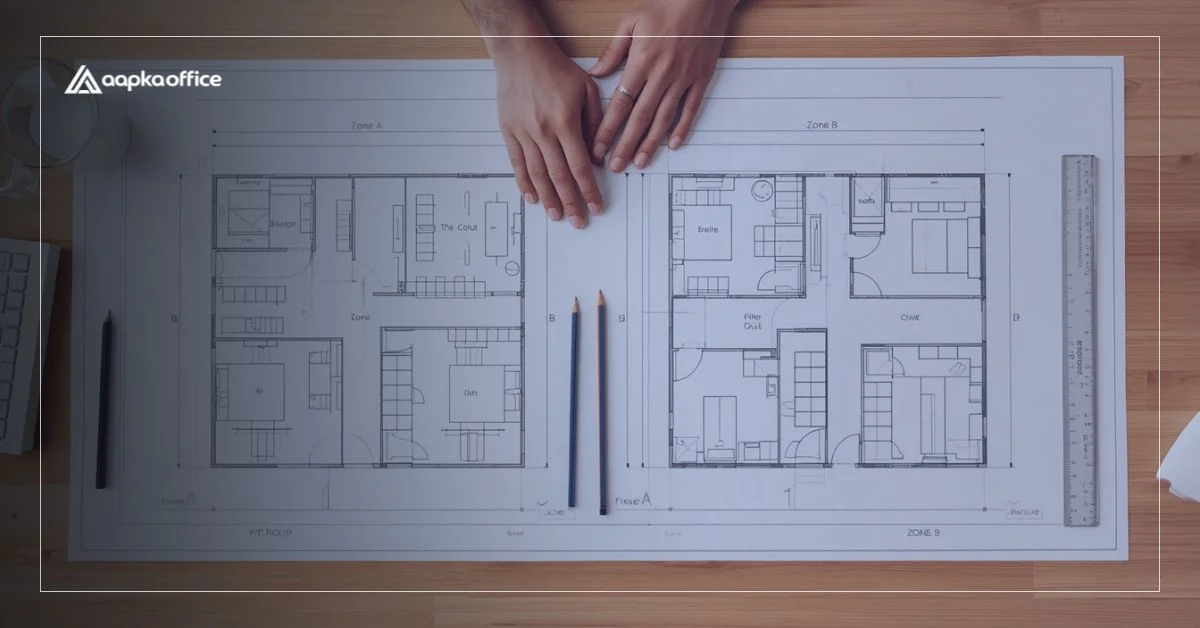
Density-tiered design challenges this by creating distinct zones within the floor that operate at different density standards — allowing the same floor to accommodate a wider range of headcounts without reconfiguration.
The three-zone density model:
Zone A — High-density core (60 sq ft per workstation):
The most compactly designed area — a dense open-plan zone with bench desking, shared storage, and activity-based working philosophy. This zone is designed from Day 1 and is immediately occupied at full density. It accommodates the current headcount with room to grow.
Zone B — Standard-density expansion (100 sq ft per workstation):
An area fitted out at standard density — dedicated desks with moderate workstation spacing. This zone is fitted out in Phase 2 (Month 12 to 18) when the headcount growth is confirmed and the additional space is needed.
Zone C — Flexible / collaboration anchor (160 sq ft per person in meeting and collaboration use):
Meeting rooms, project rooms, collaboration areas, and social spaces. These are non-workstation areas that serve the whole team regardless of headcount. This zone is fitted out fully from Day 1 as it serves the core team from the beginning.
Worked example for 7,000 sq ft:
| Zone | Area | Density Standard | Workstations | Phase |
| Zone A (High-density core) | 2,800 sq ft | 60 sq ft/seat | 46 seats | Day 1 |
| Zone B (Standard expansion) | 2,100 sq ft | 100 sq ft/seat | 21 seats | Month 12–18 |
| Zone C (Collaboration) | 2,100 sq ft | Collaboration | — | Day 1 |
| Total | 7,000 sq ft | 67 seats max |
Day 1 capacity: 46 workstations in Zone A + collaboration (Zone C) for all
Month 18 capacity: 67 workstations after Zone B is fitted out
Cost per seat at different headcounts:
| Headcount | Zone A Only | Zones A + B | Rent (₹/month) | Cost per Seat |
| 35 people | Zone A only | — | ₹5,25,000 | ₹15,000 |
| 46 people | Zone A full | — | ₹5,25,000 | ₹11,413 |
| 55 people | Zone A + partial B | Zones A + B | ₹5,25,000 | ₹9,545 |
| 67 people | Zones A + B full | — | ₹5,25,000 | ₹7,836 |
By designing for a range of densities rather than a single standard, the space remains functionally adequate from 35 people through 67 people — without major reconfiguration — and the cost per seat remains within a manageable range.
5. Strategy 3 — Modular Partition Systems
Traditional office partitions — dry-wall construction, fixed glass panels, permanent plasterboard walls — are expensive to build (₹1,800 to ₹3,000 per running metre) and expensive to remove or modify (₹800 to ₹1,500 per running metre for demolition). A layout change when headcount grows requires renegotiating with the building management, hiring a contractor, and accepting disruption costs.
Modular partition systems — demountable glass, aluminium frame, or modular acoustic partitions — change this economics fundamentally.
What modular partitions offer:
- Reconfiguration cost of ₹300 to ₹600 per running metre (move and reinstall versus ₹2,600 to ₹4,500 per running metre for demolish and rebuild)
- Reconfiguration time of 1 to 3 days for a standard office versus 2 to 4 weeks for conventional partition work
- No building management approval required for reconfiguration (the partition is a tenant-owned asset that does not affect the building structure)
- Residual value at lease end — modular partitions can be moved to the next office rather than being written off
The financial impact over a 3 to 5 year lease:
For a company that reconfigures its space twice over 5 years (once at Month 18 to add a team zone, once at Month 36 to convert a meeting room into a workstation area):
| Partition Type | Initial Installation | 2 Reconfigurations | Total 5-Year Cost |
| Dry-wall conventional | ₹18,00,000 | ₹2 × ₹9,00,000 = ₹18,00,000 | ₹36,00,000 |
| Modular demountable | ₹24,00,000 (higher initial) | ₹2 × ₹3,00,000 = ₹6,00,000 | ₹30,00,000 |
The modular system is more expensive to install initially — typically 30 to 40% higher capital cost — but is 17% cheaper over 5 years when reconfiguration cost is included. More importantly, it enables reconfiguration without operational disruption or building management delays.
In the Indian NCR market:
Modular partition systems are available from several domestic and imported suppliers in the Delhi NCR market. The premium over standard dry-wall construction is approximately ₹800 to ₹1,200 per running metre. For a 500 sq ft private office zone with 50 running metres of partition: premium is ₹40,000 to ₹60,000 — a modest investment for the reconfiguration flexibility it provides.
6. Strategy 4 — Activity-Based Working (ABW) to Increase Effective Density
Activity-based working — the practice of not assigning dedicated desks to individual employees, but providing a range of workspace types that employees choose based on the activity they are performing — allows a space to support a higher headcount than its workstation count suggests.
The ABW density mechanism:
In a standard assigned-desk office, every employee needs one desk — even when they are in meetings, on a call in a phone booth, or working from home 2 days per week. At a 40% work-from-home rate and 20% of the day in meetings, the average desk is occupied for approximately 48% of the business day.
In an ABW model, the total desk count is set at 70 to 80% of headcount — the occupancy rate at any given time for an office with moderate hybrid work adoption. The remaining 20 to 30% of the workforce’s time is accommodated in meeting rooms, phone booths, project tables, and other non-assigned spaces.
The cost per seat impact:
On a 7,000 sq ft floor with 70 assigned desks at 100 sq ft per desk:
- ABW model supporting 90 to 100 people (70 desks plus meeting and collaboration capacity)
- Effective sq ft per person at 95 people: 7,000 ÷ 95 = 73.7 sq ft
- Cost per seat at ₹5,25,000 monthly rent: ₹5,526
Versus:
- Assigned-desk model at 100 sq ft per person supporting 70 people
- Cost per seat at ₹5,25,000 monthly rent: ₹7,500
The ABW model reduces the effective cost per seat by 26% — from ₹7,500 to ₹5,526 — by increasing the headcount the same floor supports.
Important caveats for ABW in India:
ABW works well for roles with high meeting intensity, varied task types, and moderate work-from-home adoption. It works poorly for roles requiring continuous focused attention with high equipment density (trading desks, audio engineering, laboratory work). Most technology and professional services firms in India’s GCC market have workforces where ABW is appropriate for 60 to 75% of roles.
The headcount buffer ABW provides:
If a company plans for 70 people and designs an ABW office for 70 desks, it can actually accommodate 85 to 90 people before the space feels overcrowded — a headcount buffer of 20 to 30% without additional space. This buffer reduces the urgency of expansion when growth is 20% ahead of plan.
7. Strategy 5 — The Subletting Provision in the Lease
The strategies above address physical design. This strategy addresses the lease structure — specifically, the ability to recover rent cost from a third party when space is not being utilised.
The subletting provision:
A lease clause allowing the tenant to sublet a portion of the leased area — to another company who pays a sublease rent — converts empty space from a pure cost to a partial revenue generator.
When this matters:
Company takes 8,000 sq ft expecting 80 people by Year 2. Actual headcount at Year 1: 50 people, occupying 5,000 sq ft. The remaining 3,000 sq ft is unused.
With subletting:
- Sublet 3,000 sq ft to a 25-person startup at ₹45 per sq ft per month (below market — incentive to sublease)
- Sublease income: ₹1,35,000 per month
- Net rent cost to primary tenant: ₹6,00,000 – ₹1,35,000 = ₹4,65,000
- Effective rent per occupied sq ft: ₹4,65,000 ÷ 5,000 = ₹93 per sq ft
Without subletting: ₹6,00,000 ÷ 5,000 = ₹120 per sq ft
What to negotiate in the lease:
Most Grade B leases in GCER and Noida allow subletting with the landlord’s prior written consent — which in practice can take 2 to 4 weeks and may be conditional. For a tenant who wants to use subletting as an active space management tool, negotiate:
“The Tenant shall have the right to sublet a portion of the Demised Premises not exceeding [40]% of the total area to any party engaged in [commercial office activity], subject to written notice to the Landlord and without requiring the Landlord’s consent, provided the subtenant’s use does not breach any building regulation or void any insurance policy.”
The removal of the consent requirement (replaced with a notification requirement) makes subletting operationally practical rather than theoretically available.
8. Strategy 6 — The Expansion Option Clause
The expansion option gives the tenant the right to take additional space in the same building at a pre-agreed mechanism when their headcount growth requires it — without having to negotiate a new lease or compete with other tenants for the space.
How it works:
The lease includes a clause such as:
“The Tenant shall have the right of first refusal on any space becoming available in the Building during the Lease Term. The Landlord shall notify the Tenant in writing within 5 Business Days of any space becoming vacant. The Tenant shall have 21 days to elect to take the available space at the following rent: [current rent per sq ft escalated by the same percentage as the main lease at the last escalation date].”
The financial impact:
Without an expansion option, a company that needs additional space when its building is 15% vacant must negotiate market terms — which may be 15 to 20% above the original lease rent if the market has tightened in the intervening period. With an expansion option at the original lease’s escalated rent, the tenant captures below-market expansion terms.
On a 3,000 sq ft expansion in Year 2:
| Scenario | Expansion Rent | Annual Expansion Cost |
| Market terms (15% above original) | ₹83 per sq ft | ₹29,88,000 |
| Expansion option at escalated lease rate | ₹79.2 per sq ft (₹72 × 1.1) | ₹28,51,200 |
| Annual saving from option | ₹1,36,800 | — |
Over 3 remaining years of the lease: ₹4,10,400 saved by having the expansion option.
9. The Integrated Design Strategy — Combining All Six Approaches
The maximum financial benefit from managing headcount uncertainty comes from combining multiple strategies rather than applying any single one.
The integrated design model for a 50-person company taking 7,000 sq ft in GCER Gurugram:
Physical design choices:
- Phase 1 fit-out (4,500 sq ft): Zone A high-density core (2,400 sq ft) + Zone C collaboration (2,100 sq ft)
- Phase 2 fit-out (2,500 sq ft): Zone B standard expansion, deferred to Month 15 to 18
- Modular partition system throughout all fitted areas
- ABW model in Zone A: 40 desks serving up to 52 people with hybrid work adoption
Lease structure choices:
- Expansion option on any available space in the building, at escalated lease rate
- Subletting right for up to 30% of area without landlord consent
- Break clause at Month 30 with 90-day notice
- Fit-out period: 12 weeks (before rent starts)
Year-by-year financial model:
Month 1 to Month 18 (current headcount 40 to 50):
Zone A + Zone C fitted out (4,500 sq ft occupied + 2,500 sq ft shell) Monthly rent: ₹5,25,000 (full floor)
Options:
- Sublet 2,000 sq ft of shell area: income ₹90,000/month → net rent ₹4,35,000
- Do not sublet, absorb the shell cost
At 45 people with subletting: effective cost per seat = ₹4,35,000 ÷ 45 = ₹9,667
Month 18 to Month 36 (headcount 55 to 70):
Zone B fitted out, full floor in use Monthly rent: ₹5,77,500 (after 10% escalation) No subletting needed — space is utilised
At 65 people: effective cost per seat = ₹5,77,500 ÷ 65 = ₹8,885
Month 36 to Month 60 (headcount 70 to 85, expansion needed):
Expansion option exercised: 2,500 sq ft adjacent space at ₹79.2 per sq ft Total area: 9,500 sq ft Monthly rent: ₹5,77,500 + ₹1,98,000 = ₹7,75,500
At 80 people: effective cost per seat = ₹7,75,500 ÷ 80 = ₹9,694
The complete 5-year cost per seat trajectory:
| Period | Headcount | Monthly TCO (net) | Cost Per Seat |
| Month 1–18 (subletting) | 45 | ₹4,35,000 | ₹9,667 |
| Month 18–36 | 65 | ₹5,77,500 | ₹8,885 |
| Month 36–60 (expansion) | 80 | ₹7,75,500 | ₹9,694 |
The cost per seat remains within a ₹800 range across a 5-year period in which headcount nearly doubles — a 78% reduction in cost per seat volatility compared to the standard approach.
10. The Fit-Out Investment Choices — What to Spend On and What to Defer
Within the Phase 1 fit-out, specific choices determine how efficiently the space operates at below-target occupancy and how easily it transitions when the headcount arrives.
Invest fully in Day 1 (do not defer):
- Electrical wiring and distribution board for the full floor (it is expensive to extend this later; doing it fully initially is far more cost-efficient)
- HVAC zoning controls for the full floor (necessary for the shell area to be liveable if used for storage or informal work)
- Core IT infrastructure — server room, main network cabinet, primary cabling backbone
- Fire safety compliance across the full floor
- Kitchen and welfare facilities for the expected peak headcount (not just the current headcount — the kitchen capacity limits the floor’s maximum occupation)
Defer to Phase 2:
- Workstation furniture (Zone B desks, chairs, storage)
- Zone B partition work
- Secondary cabling to Zone B workstations
- Zone B lighting circuits (though the main electrical circuit should be in place)
Invest in flexibility from Day 1:
- Modular partitions rather than dry-wall for all primary workspace dividers
- Raised floor or accessible floor void for cable management flexibility (more expensive initially; eliminates recabling cost on every reconfiguration)
- Standardised workstation units that can be rearranged without specialist installation
11. The Building Management Conversation — Getting Approval for Phased Design
In NCR’s commercial market, building management approval for fit-out designs is required in most Grade A and Grade B buildings. A phased fit-out plan that leaves a portion of the floor unfitted may require a specific conversation with the building management.
What building managers typically worry about:
- An unfitted shell area that is used improperly — as storage for hazardous materials, as informal accommodation, or as a sublease to parties the building management has not vetted
- Fire safety compliance for the shell area — unfitted areas still need compliant emergency lighting, exit signage, and access to the building’s fire suppression
- Building security — an access-controlled tenant floor with an unfitted area can create security ambiguity
How to address these concerns in the approval process:
Present the phased fit-out plan to the building management explicitly at the LOI stage — before the lease is signed. Specify:
- The shell area will be used for [storage / staged fit-out] and will not be sublet without the building management’s notification
- Basic fire safety (emergency lighting, exit signage) will be installed in the shell area from Day 1
- Access to the shell area is controlled by the same tenant access system as the fitted area
A building manager who receives this plan proactively is far more likely to approve it than one who discovers the shell area existence after possession.
What Headcount-Adaptive Office Design Actually Achieves
The strategies in this guide do not eliminate the cost of headcount uncertainty. They reduce it — by ensuring that the space operates at a manageable cost per seat across a realistic range of growth scenarios, rather than swinging dramatically between over-utilisation and under-utilisation at the extremes.
A company that designs its office with these strategies from the start will, on average:
- Reduce the upfront capital deployment in Year 1 by ₹30 to ₹50 lakh on a 5,000 to 8,000 sq ft space
- Maintain cost per seat within a ±15% range across a 2x headcount growth scenario
- Avoid the operational disruption and cost of a second relocation when growth outruns the original space
- Create optionality — subletting, expansion, break clause — that allows the real estate strategy to adapt as the business strategy evolves
None of these outcomes require exceptional design talent or unusual lease terms. They require applying a specific set of well-understood strategies — phased fit-out, density tiering, modular partitions, ABW design principles, and lease clauses that create flexibility — systematically from the beginning of the leasing process.
The companies that do this well treat the office decision as what it actually is: a multi-year financial commitment with specific risk exposure, which should be managed with the same discipline applied to any other commitment of equivalent size.