
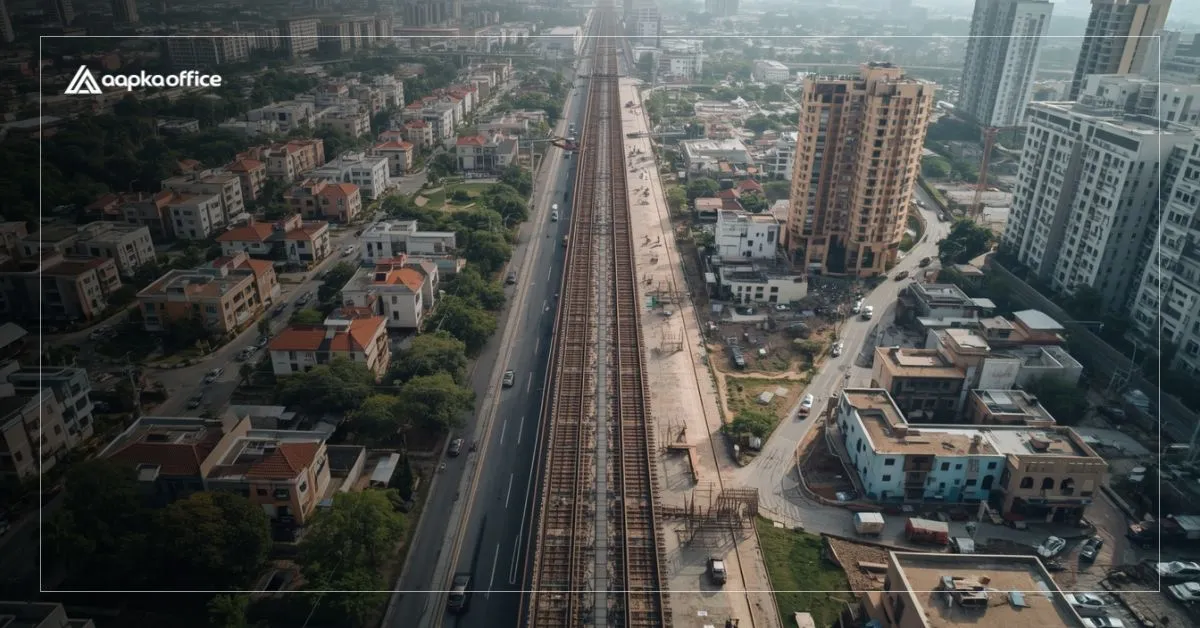
The relationship between metro access and commercial property value is one of the most reliably documented patterns in urban real estate.
When a metro station opens in a location that previously had no rapid transit access, two things happen in sequence. The immediate effect is accessibility — the station connects the area’s resident population to the broader city and connects the city’s workforce to this location. The lagged effect — typically 18 to 48 months after station opening — is commercial rent appreciation as businesses recognise the improved talent access and start competing for the limited available space.
Tenants who sign leases after the rent appreciation cycle has run are paying for the accessibility. Tenants who sign leases during the accessibility improvement — before the market has priced in the new metro connectivity — are capturing the benefit that the metro brings without paying the premium that follows.
This is the opportunity that most tenants miss.
Delhi NCR’s metro network has been in active expansion across multiple corridors since 2020 — Phase 4 sections of the Delhi Metro, Gurugram Metro’s new network, Noida’s Aqua Line extensions, and the Rapid Rail Transit System (RRTS) corridors that functionally alter the commute geography of the entire NCR. Each expansion creates a new commercial opportunity window — typically 12 to 36 months during which the improved accessibility is real but the commercial market has not yet fully repriced.
This guide identifies the specific corridors in Delhi NCR where metro expansion is creating commercial leasing opportunities that tenants have not yet identified, evaluates the current opportunity in each, and provides the analytical framework for assessing whether a specific emerging corridor represents genuine long-term value or temporary optimism.
1. The Metro Effect — How Transit Access Changes Commercial Property
Before the specific corridors, the mechanism. Understanding how metro access affects commercial real estate prevents the mistake of treating every new station as an equal opportunity.
The Five-Phase Commercial Property Response to a New Metro Station
Phase 1 — Pre-opening (12 to 24 months before opening):
Construction is visible. The station exists physically but does not operate. Commercial property owners begin marketing the coming connectivity. Asking rents start rising in anticipation. Sophisticated tenants begin identifying opportunities.
Phase 2 — Opening and early operation (0 to 12 months after opening):
The station is open. Footfall is building. But the commercial ecosystem has not yet responded fully — the restaurants, services, and ancillary businesses that form around a busy metro station have not opened yet. The commercial property market has partially priced in the connectivity but has not fully repriced.
This is the optimal leasing window for tenants. Accessibility is real. The commercial premium is partial rather than full.
Phase 3 — Ecosystem development (12 to 36 months after opening):
The station’s footfall stabilises. Commercial ecosystem builds up — retail, F&B, professional services. Office tenants begin arriving in larger numbers. Rents begin rising meaningfully as demand increases relative to supply.
Phase 4 — Maturation (36 to 60 months after opening):
The station is fully embedded in commute patterns. Commercial rents have appreciated 20 to 45% from pre-opening levels for well-located properties. The best spaces are occupied. Vacancy is declining.
Phase 5 — Establishment (60+ months):
The corridor is established. Rents reflect the metro connectivity premium fully. The opportunity for below-market entry has passed.
The implication:
Tenants who lease in Phase 2 capture the metro connectivity benefit at Phase 1 prices — or slightly above. Tenants who wait until Phase 4 pay full metro premiums. The difference between Phase 2 and Phase 4 pricing in a well-executed metro corridor is typically 25 to 40%.
What Determines the Commercial Opportunity Quality of a Metro Corridor
Not every new metro station creates a significant commercial opportunity. The stations that generate the strongest commercial real estate response share specific characteristics:
Population density in the catchment: A station in a dense residential neighbourhood — with 50,000 to 2,00,000 residents within 1.5 km walk distance — generates strong commercial footfall.
Connectivity to employment centres: A station that provides a direct or one-change connection to the major employment clusters (Cyber City, Connaught Place, Sector 62, Noida) dramatically increases the location’s attractiveness for both workforce access and as a business location.
Available commercial land and buildings: A metro station in a dense, fully built-out residential area may generate retail footfall, but no commercial office opportunity, because there is no available commercial floor space for businesses to occupy.
Land use classification: The area’s development plan must permit commercial use. A residential-classified zone that happens to be next to a metro station does not automatically become a commercial zone.
Exit alignment and approach: The station exit orientation relative to the residential and commercial density determines which side of the station benefits commercially. The exit facing the high-density residential zone typically generates the highest footfall.
2. Delhi Metro Phase 4 — The Corridors to Watch
Delhi Metro Phase 4 encompasses several new lines and extensions approved and under construction since 2018, with sections opening progressively through 2024 to 2027.
Corridor 1 — Aerocity to Tughlaqabad (Silver Line / Line 8 Extension)
Current status: Under construction — completion expected in phases through 2025 to 2026
The corridor:
This extension connects Indira Gandhi International Airport’s Aerocity commercial hub southward through the South Delhi residential belt toward Tughlaqabad. The key stations in the middle of this corridor — passing through areas including Kishangarh, Vasant Kunj, and the Saket-adjacent zones — create new commercial access points in a part of South Delhi that was previously underserved by rapid transit.
The commercial opportunity:
Aerocity itself is an established commercial hub — hotel and hospitality concentration, the emerging office market around Terminal 3, and the logistics and travel-adjacent businesses that cluster near airports. The southward extension changes the commercial calculus for two specific areas:
Vasant Kunj commercial area: Currently accessible primarily by road — the congestion on the MB Road and Nelson Mandela Marg approaches makes commute predictability poor. Metro access converts Vasant Kunj commercial buildings from road-access-dependent to metro-accessible — which meaningfully expands the talent pool and reduces commute friction for businesses located here.
Current rents in Vasant Kunj commercial: ₹70 to ₹110 per sq ft per month. Post-metro expected trajectory: ₹85 to ₹140 per sq ft over 3 to 4 years after station opening.
The pre-opening window: Businesses leasing in Vasant Kunj commercial today — before the metro opens and before the market fully prices in the improved connectivity — are accessing the location at current rents. The 18 to 24 month window before the stations in this corridor open is the optimal entry point.
Who should consider it: Professional services firms, consulting practices, and mid-size technology companies with South Delhi and Vasant Kunj residential concentration in their workforce. The improved connectivity to the airport (via the Silver Line) also benefits businesses with frequent business travel requirements.
Corridor 2 — Janakpuri West to RK Ashram Marg (Pink Line Extension)
Current status: Partially operational, with remaining sections completing through 2025
The corridor:
The Pink Line’s western extension covers a dense residential belt in West and South-West Delhi — connecting Janakpuri, Vikaspuri, and the Subhash Nagar area to the central Delhi network. Several commercial nodes along this route have been underserved by metro connectivity.
The commercial opportunity:
Janakpuri District Centre: One of Delhi’s planned commercial districts — with a mix of offices, retail, and institutional buildings — that has historically had limited direct metro access. The Pink Line extension substantially improves this, connecting Janakpuri directly to the central Pink Line route covering Lajpat Nagar, Hazrat Nizamuddin, and connecting to the East Delhi commercial zone.
Current commercial rents in Janakpuri District Centre: ₹75 to ₹110 per sq ft per month. The area has meaningful Grade B commercial stock — including DDA-developed commercial blocks — that has underperformed relative to its residential catchment because of transit limitations.
What changes: The Pink Line connection converts Janakpuri from a road-dependent location to a metro-connected one for the first time. The residential catchment — dense middle-income West Delhi — becomes accessible as a workforce pool for businesses that locate here. Companies with workforce concentrated in West Delhi (Janakpuri, Vikaspuri, Dwarka, Uttam Nagar) gain significant commute efficiency.
Who should consider it: Businesses with predominantly West Delhi workforce; BFSI, professional services, and operations-heavy firms serving the West Delhi consumer market; SMEs seeking Delhi Grade B space at ₹75 to ₹100 per sq ft with improving metro connectivity.
Corridor 3 — Mukundpur to Shiv Vihar (Pink Line — North-East Delhi Extension)
Current status: Operational (Pink Line’s northern extension is largely complete)
The corridor:
The Pink Line’s north-eastern extent covers a dense, previously metro-underserved residential belt — passing through Maujpur, Gokulpuri, Jaffrabad, Mustafabad, and terminating at Shiv Vihar. This is East Delhi and North-East Delhi territory — high population density, historically poor metro access, significant middle-income residential concentration.
The commercial opportunity:
North-East Delhi’s commercial market has been structurally disadvantaged for two decades — accessible by road through heavily congested corridors (NH-24, Wazirabad Road) and previously requiring journey times of 45 to 90 minutes to reach central Delhi employment centres.
The Pink Line changes this. A resident of Mustafabad or Gokulpuri can now reach Lajpat Nagar in 25 minutes, Rajiv Chowk in 40 minutes. This is a commute transformation that opens the North-East Delhi residential talent pool to businesses located anywhere on the Pink Line route.
The direct commercial opportunity:
Commercial space along the Pink Line in North-East Delhi is not high-quality stock — the area’s commercial buildings are predominantly Grade C and old Grade B. The opportunity is not for premium Grade A office tenants.
The opportunity is for businesses with specific catchment requirements: customer service centres targeting the North-East Delhi consumer population, BFSI branches serving the area’s significant unbanked and under-banked demographic, healthcare and diagnostics operations targeting the residential population, and D2C brands seeking operational teams drawn from the local population.
Current commercial rents: ₹40 to ₹65 per sq ft per month — among the lowest in metro-connected Delhi.
Corridor 4 — Delhi-Ghaziabad-Meerut RRTS (Sahibabad to Meerut South)
Current status: The Delhi-Meerut RRTS Sahibabad to Duhai Depot section is operational. Extension toward Meerut and the Delhi section is under development.
This is the most significant commercial property opportunity created by Delhi NCR’s transit expansion — and the least noticed by the commercial leasing market.
What the RRTS is:
The Rapid Rail Transit System is qualitatively different from the Delhi Metro. The RRTS is a high-speed rail system — trains running at 160 km/h design speed, with station spacing designed for city-to-city travel rather than neighbourhood-to-neighbourhood access. The Delhi-Meerut RRTS covers 82 km in approximately 60 minutes — making Meerut effectively a commutable distance from central Delhi.
The commercial opportunity:
The RRTS creates two distinct commercial opportunities:
The Sahibabad / Ghaziabad commercial node:
Sahibabad and the industrial areas of Ghaziabad — historically inaccessible to the Delhi talent pool for office employment — are now connected to Delhi by the RRTS. The industrial and manufacturing ecosystem in Ghaziabad (electronics, auto components, pharmaceuticals, FMCG) has never had adequate commercial office infrastructure because the commute barrier prevented talent from the Delhi side accepting jobs here.
RRTS changes this. Sahibabad RRTS station is approximately 20 to 25 minutes from New Delhi RRTS station — comparable to a Blue Line metro journey from Rajiv Chowk to Noida Sector 62.
Current commercial rents in the Sahibabad / Ghaziabad market: ₹35 to ₹65 per sq ft per month — among the lowest in metro or rapid rail-connected NCR. For operations-heavy businesses with large teams, the per-seat cost advantage is dramatic.
The corridor stations between Ghaziabad and Meerut:
As the RRTS extends toward Meerut, each intermediate station — Muradnagar, Modinagar — becomes a potential location for operations and manufacturing-adjacent offices seeking low rents and improving transit connectivity to Delhi. These are genuinely emerging markets with 5 to 10 year development horizons rather than immediate commercial opportunities, but forward-planning businesses and real estate investors are already evaluating them.
Who should consider the RRTS corridor:
Manufacturing-linked corporate offices, BFSI operations, large-scale customer service and operations centres, and businesses whose workforce comes from the East UP and Western UP demographic. The RRTS corridor opens a talent pool of millions that is currently underutilised for Delhi NCR commercial employment.
3. Gurugram Metro — The New Opportunity Corridors
Corridor 5 — Gurugram Metro Phase 1 (Sector 5 to Sector 22 and beyond)
Current status: The Gurugram Metro (separate from the Delhi Metro’s Yellow Line extension) is under construction — Haryana Rail Infrastructure Development Corporation (HRIDC) project with a planned network through Southern Gurugram.
The corridor:
Gurugram’s new metro network covers the southern and eastern parts of the city that are currently served only by road — including the rapidly growing residential sectors (47 to 80) and the commercial belt along Sohna Road and beyond.
The commercial opportunity:
Gurugram’s commercial market has been dominated by the corridors that already have metro access — the Delhi Metro Yellow Line (HUDA City Centre, MG Road stations) and the Gurugram Rapid Metro (Cyber City). The areas currently served only by road — GCER’s southern sections, Sohna Road, Sectors 57 to 65 — have been priced at a discount to the metro-connected corridors.
As the Gurugram Metro network progresses, the commercial zones along the new route will receive their first rapid transit connectivity. The pre-opening window for these locations is open now — before the network is operational and before the market reprices.
Specific zones to watch:
GCER Southern Belt (Sectors 57 to 65): Already a high-vacancy commercial market (as analysed in the heatmap blog). The addition of metro access would transform a market with one fundamental disadvantage (road-only access) into a market with a genuine cost advantage combined with metro connectivity. Businesses that lease here now — at high-vacancy discounted rents — would be in a lease that looks dramatically different post-metro opening.
Sohna Road commercial: Currently reliant entirely on road access from NH-48. Metro access would expand the commercial catchment significantly and improve talent access from the southern residential belt.
The caution:
Infrastructure project timelines in India routinely extend beyond official estimates. The commercial opportunity from the Gurugram Metro is real — but its timing is subject to construction and approval timelines that have historically been variable. Factor in a 12 to 18 month buffer from official opening dates when planning around this corridor.
Corridor 6 — Delhi Metro Yellow Line Extension toward Gurugram Sectors
Current status: The Delhi Metro Yellow Line terminates at HUDA City Centre / Millennium City Centre, Gurugram. The Gurugram sector extension (Sectors 22 and beyond) is in planning stages.
The commercial opportunity:
HUDA City Centre is already an established commercial hub — the terminus effect that metro terminus stations typically produce (high footfall, commercial density at the end of the line) is fully visible here. The opportunity is in the extension’s first few stations into the underpenetrated sectors.
The commercial potential of direct metro access for Sectors 22 to 35 in Gurugram — which currently have strong residential density but commercial real estate that is road-dependent — is significant.
4. Noida and Greater Noida — Metro Extension Opportunities
Corridor 7 — Aqua Line Extension (Noida to Greater Noida West and Knowledge Park)
Current status: The Noida Metro Aqua Line (Sector 51 to Depot Station) is operational. Extensions are planned and at various stages of approval and construction.
The corridor:
The Aqua Line extension toward Greater Noida West — the large residential development in the Gaur City, Noida Extension, and Bisrakh area — would connect India’s largest residential cluster without metro access (approximately 8 to 12 lakh residents) to the Noida commercial ecosystem.
The commercial opportunity:
Greater Noida West is a massive residential zone whose commercial potential has been constrained by its road-only access. The existing road connections — through NH-9 and through Sector 62 — are severely congested at peak hours, making the area functionally unattractive for commercial office tenants who need to attract workforce.
An Aqua Line extension would transform Greater Noida West from a road-dependent residential zone into a metro-connected location — connecting it to Sector 62 Noida, and through the Blue Line interchange, to the entire Delhi Metro network.
The pre-extension window:
Commercial rents in Greater Noida West are currently among the lowest in residential-adjacent NCR: ₹30 to ₹55 per sq ft per month for Grade B commercial buildings. Post-metro, the trajectory would be meaningfully upward — likely to ₹50 to ₹80 per sq ft over 3 to 5 years of post-opening repricing.
For businesses whose workforce is concentrated in Greater Noida West, Noida Extension, and Crossings Republik — which describes a growing segment of the NCR’s technology and operations workforce — a Greater Noida West commercial location at current pre-metro rents is a compelling opportunity.
The risk: Extension timeline. The Aqua Line extension has been in planning for several years. Confirmation of the construction timeline is important before making a long-term lease commitment based on the metro connectivity thesis.
Corridor 8 — Blue Line Extension toward Sector 62 Elevated Stations
Current status: The Blue Line currently serves Sector 62 (Noida City Centre and Sector 34 stations, with Sector 62 as a significant destination). Infrastructure upgrades improving capacity and frequency are ongoing.
The Sector 63 / 65 commercial spillover:
As Sector 62’s commercial market absorbs GCC and BFSI demand (as analysed in the sectoral demand blog), rental pressure in the most established part of the cluster will push demand toward adjacent sectors — Sector 63 and 65 — that are within walking or short auto distance from the Sector 62 metro station.
These adjacent sectors currently have commercial rents 10 to 20% below Sector 62 proper — a discount that reflects the slightly longer metro access rather than any structural disadvantage. As Sector 62 tightens, this discount will narrow and eventually disappear for the best-located buildings.
The opportunity: Commercial buildings in Sectors 63 to 65 that are within 600 to 800 metres of the Sector 62 metro station access points are priced at a metro-adjacency discount today. This discount will reduce as Sector 62 tightens and as tenants recognise that the actual walk time to the station is manageable.
5. The RRTS Network — The Longer-Term Commercial Opportunity
The RRTS (Rapid Rail Transit System) network — Delhi to Meerut operational in phases, Delhi to Panipat and Delhi to Alwar in development — represents the largest single transit infrastructure investment in NCR’s history. Its commercial real estate implications are not yet priced into the market because the full network’s impact is 5 to 10 years away.
The Delhi-Meerut RRTS commercial opportunity (2025 to 2030):
The operational Sahibabad to Duhai section has already created improved connectivity for the industrial Ghaziabad belt. As the network extends to Meerut South and eventually into Delhi (Sarai Kale Khan, Anand Vihar, New Delhi), the commercial implications compound:
- Anand Vihar RRTS station (in development): Connects the RRTS to the Delhi Metro at Anand Vihar (Blue Line, Pink Line) — potentially the highest-connectivity node in East Delhi. Commercial properties within 500 metres of Anand Vihar RRTS would be at the intersection of multiple transit systems and a massive residential catchment.
- New Delhi RRTS station (long-term): Connects the RRTS network to Connaught Place and central Delhi — making the entire RRTS corridor functionally part of the central Delhi commercial zone.
The Delhi-Alwar RRTS corridor:
The Delhi-Alwar RRTS passes through Gurugram (with a proposed station near Rajiv Chowk, Gurugram, and further stations toward Manesar and Alwar). Manesar — India’s largest automotive manufacturing cluster — would receive rapid rail connectivity to Delhi for the first time. The commercial real estate implications for Manesar’s industrial office market are significant but remain 5 to 8 years in the future.
6. The Analytical Framework — Evaluating an Emerging Metro Corridor
Before committing to a lease in an emerging metro-adjacent corridor, evaluate the opportunity against these five criteria.
Criterion 1 — Construction Timeline Realism
Indian infrastructure project timelines are subject to revision. A corridor that is “opening in 12 months” per official announcements may actually open in 18 to 30 months. A corridor that is in early construction may be 4 to 6 years away.
How to assess: Visit the construction site and observe the progress relative to the stated timeline. Check the official tender and contract records (available on the relevant authority’s website) for the construction completion date specified in the main contract. Apply a realistic buffer — typically 12 to 18 months — to official completion dates for infrastructure projects that have not yet reached 70% physical completion.
Criterion 2 — Connectivity Quality Assessment
Not all metro connectivity is equal. The commercial value of a metro station depends on where it connects to — specifically, whether it connects to the city’s major employment and commercial centres with a direct route or with multiple changes.
A station that connects directly (no change) to Rajiv Chowk, Cyber City, or Connaught Place is more valuable for commercial real estate than one that requires 2 to 3 changes to reach the same destinations.
Map the journey time from the proposed station to the three most relevant destinations for the target workforce — not just the distance, but the door-to-door journey time including walks to and from the station.
Criterion 3 — Residential Density Assessment
The station’s catchment population — within 1 to 1.5 km walk distance — determines the workforce pool available to businesses locating here.
How to assess: Walk the 1 km radius from the station exit point and observe the density and character of the residential area. High-density residential within walking distance creates a genuine workforce access benefit. If the 1 km catchment is primarily commercial or institutional, the residential workforce benefit is limited.
Criterion 4 — Commercial Space Availability and Quality
The station must be adjacent to available commercial space that meets the tenant’s specification requirements. A station surrounded by Grade A residential buildings with no commercial floor space provides no leasing opportunity regardless of the connectivity.
How to assess: Map the available commercial properties within 500 metres of the station exit. Assess the quality, current vacancy, and asking rents. Determine whether the landlords have begun pricing in the coming metro connectivity (asking prices rising) or whether the market has not yet repriced.
Criterion 5 — The Lease Term Match
Emerging metro corridors require a specific lease term strategy. A 2-year lease on an emerging corridor means the tenant leaves just as the metro opens and the market tightens — capturing none of the benefit. A 5-year lease with a break clause at year 2 or 3 allows the tenant to capture both the pre-metro pricing and the post-metro option to stay (if the corridor has delivered) or exit (if the timeline has slipped significantly).
The optimal lease structure for emerging metro corridors: 5-year conventional lease with a break clause at 24 to 30 months — long enough to benefit from pre-metro rents if the corridor delivers on schedule, with flexibility if it does not.
7. The Risk Assessment — What Can Go Wrong
Emerging corridor opportunities carry specific risks that established corridor leases do not.
Risk 1 — Timeline extension:
The primary risk. Metro projects that extend 2 to 3 years beyond their official timeline mean the tenant is occupying a pre-metro-priced space in a location that has not yet received the connectivity that motivated the lease. Mitigate with: break clauses, honest timeline assessment, and confirmation that the business case works even if the metro is 24 months late.
Risk 2 — Low-quality commercial stock:
Emerging corridors often have older, lower-quality commercial buildings — because the area was not previously a commercial priority and investment in building quality was low. Tenant fit-out costs may be higher and the professional infrastructure may be less developed. Assess the building quality independently before committing.
Risk 3 — Ecosystem lag:
Even after the metro opens, the commercial ecosystem — good cafés, professional services, reliable courier access, food options for the team — takes time to develop. A business that moves to an emerging corridor immediately after metro opening may find the area lacks the supporting infrastructure that established commercial zones have. Budget 12 to 18 months of ecosystem lag into the operational planning.
Risk 4 — Over-optimism about rental appreciation:
Not every metro station produces 30 to 40% rental appreciation. Stations in areas with abundant commercial land supply, without strong residential catchment, or with poor connectivity quality may produce smaller rental uplift than anticipated. The opportunity analysis must be grounded in conservative estimates of the post-metro repricing, not in the maximum possible scenario.
8. The Three-Category Opportunity Summary
Based on the corridor analysis, the emerging metro corridors in Delhi NCR fall into three categories for 2026:
Category 1 — Act Now (12 to 18 month window before repricing):
Vasant Kunj commercial (Silver Line extension opening soon), Janakpuri District Centre (Pink Line connection improving), Sector 63/65 Noida adjacent to Sector 62 metro. These corridors have the metro connectivity arriving imminently or recently and the commercial market has only partially repriced.
Category 2 — Plan Now for 24 to 36 Months Out:
GCER Southern Belt (Gurugram Metro), Greater Noida West commercial (Aqua Line extension), Sahibabad / Ghaziabad RRTS corridor. These corridors have confirmed infrastructure investment and a plausible 24 to 36 month timeline to improved connectivity. Tenants whose lease terms align with this timeline can plan around them.
Category 3 — Monitor for Long-Term Position (36+ months):
Manesar RRTS corridor, Delhi-Alwar RRTS intermediate stations, Meerut RRTS intermediate stations, New Delhi RRTS station area. These corridors have significant long-term commercial potential but timelines are too uncertain for near-term lease decisions. Businesses with 5 to 10 year location planning horizons should have a position here.
9. What Brokers and Tenants Should Do Differently
The emerging metro corridor opportunity requires a different approach from standard commercial leasing.
For tenants:
Start the location analysis with transit infrastructure planning — not with available listings. Identify where metro access is improving, then look for available commercial space in those areas. Most commercial leasing searches start from the space and then evaluate access — reversing this order puts the transit opportunity at the centre of the analysis where it belongs.
Request from your broker a 36-month transit access projection for any location under consideration — not just current metro connectivity, but what the connectivity looks like when your lease is in Year 3 or Year 5. The location you lease today will function in the transit environment of 2028 to 2030.
For brokers:
The brokers who are generating the most value for their clients in 2026 are the ones who understand the transit infrastructure pipeline — which corridors are opening, when, and what the connectivity quality will be. This knowledge is available from public sources (DMRC, NMRC, HRIDC project announcements) but requires the effort to track and synthesise.
A broker who can walk a client through the comparative lease economics of a Vasant Kunj commercial space today versus in 2028 — with the metro connectivity adjustment — is providing market intelligence that generic brokers cannot. This intelligence is one of the clearest differentiators available to a commercial broker in the current NCR market.