
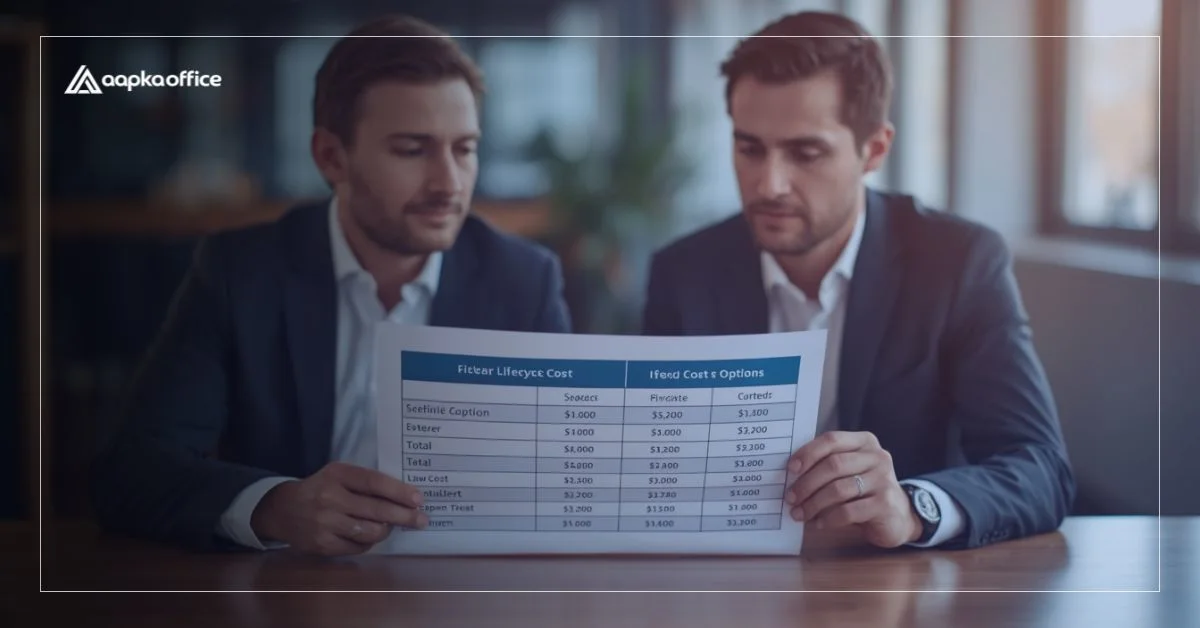
A business fits out a 5,000 sq ft office in Gurugram. Two options are on the table.
Option A costs ₹55 lakh in upfront capex. It uses standard-grade materials, basic lighting, budget HVAC units, and entry-level workstations. The project manager recommends it because it comes in under budget.
Option B costs ₹72 lakh in upfront capex. It uses mid-grade materials, LED lighting with controls, energy-efficient centralised HVAC, and ergonomic workstations. The project manager flags it as above budget.
At the point of sign-off, most businesses choose Option A. The ₹17 lakh savings look significant. The decision feels financially responsible.
By year three, Option A has cost the business more than Option B.
The LED lighting in Option B reduces electricity consumption by 30 per cent — saving ₹3.6 lakh per year. The energy-efficient HVAC reduces cooling electricity by 25 per cent — saving ₹2.4 lakh per year. The quality workstations have required no replacement. The floor has not needed repolishing. The ceiling tiles have not cracked.
Option A’s budget lighting has required three replacement cycles. Two of the HVAC units have failed and been replaced. The vinyl flooring is lifting at the seams and has been repaired twice. The workstations need replacement in year three.
The ₹17 lakh capex saving has been consumed — and then some — by a maintenance and energy opex stream that was entirely predictable from the day the cheaper specification was chosen.
This is the lifecycle costing problem. And it affects every office fit-out decision made by every business that evaluates fit-out options solely on upfront cost, which is most businesses, most of the time.
This article builds a complete framework for predicting five-year operational expenditure from initial capex choices — specific to Indian office conditions, Indian material costs, and Indian energy economics — so that fit-out decisions are made on the total cost of occupation, not on the number that appears in the contractor’s quote.
1. Why Lifecycle Costing Is Rarely Done — and Why It Should Be
Before getting into the framework, it helps to understand why lifecycle costing is so consistently skipped — because the reasons are structural, not accidental.
The budget approval problem:
In most organisations, capital expenditure and operational expenditure are managed by different budget lines, different people, and different approval processes. The facilities team gets a capex budget for the fit-out. The finance team manages the opex budget for electricity and maintenance. These are different conversations.
A facilities manager who spends ₹17 lakh more on a better-specification fit-out — reducing next year’s electricity bill by ₹6 lakh — has overspent their capex budget, even if the organisation is financially better off. The approval system creates an incentive to minimise capex regardless of the opex consequences.
The time horizon problem:
Most fit-out decisions are made by people who are accountable for the project delivery — the facilities manager, the project manager, or the leadership team at that point in time. In three years, some of these people will have moved on. The maintenance costs that result from the cheap specification will be someone else’s problem in someone else’s budget.
The information problem:
Most businesses do not have the technical knowledge to predict how much a specification choice will cost in ongoing maintenance and energy consumption. They know the contractor’s quote. They do not know the three-year maintenance cycle for each component at that specification level.
This article addresses the information problem — providing the specific data that allows lifecycle cost prediction from specification choice.
2. The Five Components of Fit-Out Lifecycle Cost
A complete lifecycle cost model for an office fit-out has five components. Most analyses include only the first two. All five must be modelled to produce a complete picture.
Component 1 — Initial Capex: The upfront cost of the fit-out — materials, labour, contractor management fees, fit-out period costs (CAM during fit-out if applicable), and professional fees (architect, MEP consultant, project manager).
Component 2 — Energy Consumption Costs: The ongoing electricity cost directly attributable to the fit-out’s specification choices — lighting, HVAC (if tenant-supplied or supplemented), electrical infrastructure, and server room cooling. This is the highest-value lifecycle variable — energy costs over five years frequently exceed the initial capex.
Component 3 — Maintenance and Repair Costs: The cost of maintaining, repairing, and periodically replacing fit-out components throughout the five-year period. Flooring, ceiling tiles, partitions, furniture, lighting fixtures, HVAC filters and units, plumbing fittings, and electrical components all have maintenance cycles that are predictable from their specification.
Component 4 — Replacement Cycle Costs: Some fit-out components have lifespans shorter than five years at certain specification levels. Cheap vinyl flooring may need replacement at year two or three. Budget-grade seating may need replacement at year three. Entry-level HVAC split units may fail at year four. These replacement costs are not maintenance — they are capital replacement events driven by the initial capex specification.
Component 5 — Reinstatement Costs (amortised): If the lease requires the tenant to restore the premises to their pre-fit-out condition at lease end, the reinstatement cost is a direct consequence of the initial capex — the more elaborate the fit-out, the higher the reinstatement cost. Amortised across the lease period, this becomes a meaningful per-month cost that must be included in the lifecycle model.
3. The Energy Cost Model — The Highest-Value Variable
Energy consumption is the single largest lifecycle variable in most office fit-outs — and the one where specification choices have the most dramatic effect. An energy consumption analysis should be conducted for every fit-out option before a capex decision is made.
3.1 — Lighting:
Lighting is typically responsible for 20 to 35 percent of an office’s electricity consumption — and the choice between specification levels produces measurable consumption differences.
Lighting specification and consumption comparison for a 5,000 sq ft office:
| Specification | Fitting type | Power consumption | Annual electricity cost (₹8 per unit, 250 days, 10 hours) |
| Budget | T8 fluorescent tubes, basic fixtures | 18 W per sq metre | ₹1,62,000 per year |
| Standard | LED panels, standard lumen output | 10 W per sq metre | ₹90,000 per year |
| Premium | LED with occupancy and daylight sensors | 6 W per sq metre | ₹54,000 per year |
Five-year lighting electricity cost differential:
- Budget vs Premium: ₹1,08,000 per year × 5 years = ₹5,40,000 in additional electricity cost
- The premium lighting specification costs approximately ₹2.5 to ₹3.5 lakh more in upfront capex on a 5,000 sq ft fit-out
- The electricity saving pays back the capex premium in 2.5 to 3 years — and the specification runs for 15 to 20 years
3.2 — HVAC (tenant-supplied or supplemental):
In offices where the tenant installs their own air conditioning — either because the building has no centralised HVAC, or because the centralised system requires supplementation for high-density zones or server rooms — the HVAC specification choice is the highest-value energy decision in the fit-out.
HVAC energy consumption for a 5,000 sq ft office:
| Specification | Unit type | COP (efficiency rating) | Annual electricity cost (₹8 per unit, 200 cooling days, 10 hours) |
| Budget | Window AC or basic split unit, 2 star BEE rating | 2.5–2.8 | ₹6,40,000 per year |
| Standard | Inverter split AC, 3 star BEE rating | 3.5–4.0 | ₹4,57,000 per year |
| Premium | Inverter cassette or ducted unit, 5 star BEE rating | 5.0–5.5 | ₹3,20,000 per year |
Five-year HVAC electricity cost differential:
- Budget vs Premium: ₹3,20,000 per year × 5 years = ₹16,00,000 in additional electricity cost
- Premium inverter HVAC costs ₹2.5 to ₹4 lakh more in capex for a 5,000 sq ft fit-out
- The electricity saving pays back the capex premium in under 18 months
The combined energy cost model (5,000 sq ft office, five years):
| Specification level | Lighting (5 years) | HVAC (5 years) | Total energy cost |
| Budget | ₹8,10,000 | ₹32,00,000 | ₹40,10,000 |
| Standard | ₹4,50,000 | ₹22,85,000 | ₹27,35,000 |
| Premium | ₹2,70,000 | ₹16,00,000 | ₹18,70,000 |
The five-year energy cost difference between budget and premium specification — on lighting and HVAC alone — is ₹21.4 lakh. This is the number that should be placed alongside the upfront capex difference before any specification decision is made.
4. The Maintenance Cost Model — What Each Component Costs to Keep Running
Every fit-out component has a maintenance profile — a predictable pattern of ongoing costs for service, repair, and periodic replacement of consumables. These costs are specification-dependent: better-grade components have lower maintenance costs, longer service intervals, and fewer failure events.
4.1 — Flooring:
Five-year maintenance cost comparison:
| Flooring type | Initial capex per sq ft | Annual maintenance (cleaning, polishing, minor repair) | Replacement likelihood in 5 years | Five-year total maintenance |
| Budget vinyl tile | ₹80–₹120 | ₹8 per sq ft per year | High — typically replaced at year 2–3 | ₹120 per sq ft (includes one replacement cycle) |
| Standard vitrified tile | ₹150–₹250 | ₹6 per sq ft per year | Low — no replacement expected in 5 years | ₹30 per sq ft |
| Premium engineered wood / quality vinyl plank | ₹350–₹600 | ₹10 per sq ft per year | Very low | ₹50 per sq ft |
For a 5,000 sq ft office:
- Budget vinyl: ₹6 lakh in five-year maintenance + replacement
- Standard vitrified: ₹1.5 lakh in five-year maintenance
The ₹4.5 lakh maintenance differential over five years, combined with the higher replacement cost of budget flooring, often makes the standard specification more cost-effective despite higher initial capex.
4.2 — False Ceiling:
Five-year maintenance cost comparison:
| Ceiling type | Initial capex per sq ft | Annual maintenance | Replacement likelihood | Five-year total |
| Budget grid ceiling with low-cost tiles | ₹120–₹160 | ₹4 per sq ft — frequent tile replacement, sagging, staining | Moderate — partial replacement at year 3 | ₹45 per sq ft |
| Standard grid with quality tiles | ₹180–₹240 | ₹2 per sq ft | Low | ₹10 per sq ft |
| Gypsum / lay-in premium | ₹280–₹400 | ₹3 per sq ft | Very low | ₹15 per sq ft |
For a 5,000 sq ft ceiling:
- Budget: ₹2.25 lakh over five years
- Standard: ₹50,000 over five years
4.3 — Workstations and Seating:
This is where budget specification produces the most visible and most costly replacement cycle — because the people who use the furniture notice its quality daily, and poor quality furniture affects comfort, productivity, and retention in ways that translate to real business cost.
Five-year workstation total cost comparison (per seat):
| Specification | Initial cost per workstation (desk + chair) | Replacement at year 3 (budget grade) | Repair costs (5 years) | Five-year total per seat |
| Budget — basic desk, basic chair | ₹8,000–₹12,000 | *₹8,000 (likely replacement) | ₹2,000 | ₹22,000 |
| Standard — modular desk, ergonomic chair | ₹18,000–₹25,000 | No replacement expected | ₹1,500 | ₹26,500 |
| Premium — height-adjustable desk, premium ergonomic | ₹35,000–₹55,000 | No replacement expected | ₹2,000 | ₹57,000 |
For a 50-seat office:
- Budget: ₹11 lakh over five years (including replacement)
- Standard: ₹12.75 lakh over five years (no replacement)
At this scale, budget and standard are close in total cost — but standard delivers dramatically better quality for a similar five-year spend, plus no disruption from a mid-lease replacement project.
4.4 — Electrical Infrastructure:
Budget electrical fit-outs — using minimum-gauge cable, low-grade MCBs, inadequate earthing, and cheap switchgear — have a predictably higher maintenance profile:
- Higher fault frequency — tripping MCBs, loose connections, socket failures
- Higher electrician call-out cost over five years
- Higher risk of a more serious electrical event that requires significant remedial work
The additional capex for properly specified electrical infrastructure — heavier gauge cable, quality switchgear, properly designed distribution — is typically ₹3 to ₹6 per sq ft more than the budget alternative. The maintenance saving is ₹2 to ₹4 per sq ft over five years, plus the avoided cost of a significant electrical remediation event.
5. The Component Replacement Calendar — Predicting When Capex Becomes Opex
Different fit-out components have different replacement lifespans at different specification levels. A lifecycle cost model must predict which components will require replacement within the five-year period — because these replacement events are not maintenance costs. They are new capex events triggered by the original specification choice.
The replacement calendar for a 5,000 sq ft office (approximate, India conditions):
| Component | Budget specification | Standard specification | Premium specification |
| LED tubes / light fittings | Year 2–3 — frequent failures | Year 4–5 — occasional | Beyond 5 years |
| *Flooring (vinyl tile) | Year 2–3 — replacement likely | Not within 5 years | Not within 5 years |
| Budget split AC units | Year 3–4 — compressor failure risk | *Not within 5 years (inverter) | Not within 5 years |
| Office chairs | Year 2–3 — gas cylinder failure, foam collapse | Year 4–5 — minor repairs only | Beyond 5 years |
| Grid ceiling tiles | Year 2–3 — sagging, staining | Year 4–5 — minor | Not within 5 years |
| Partition systems | Year 3 — connector failures | Not within 5 years | Not within 5 years |
| HVAC filters | Quarterly (budget units clog faster) | Bi-annually | Annually |
| Paint | Year 2 — touch-ups; year 4 — repaint | Year 3–4 — touch-ups only | Year 4–5 — minor touch-ups |
Aggregating the replacement calendar:
For a 5,000 sq ft office fitted out at budget specification, the five-year replacement event calendar looks approximately like this:
- Year 2: Flooring partial replacement — ₹1.5 lakh; chair replacements — ₹1.5 lakh; lighting fixture replacements — ₹60,000
- Year 3: Flooring completion — ₹1 lakh; partition repairs — ₹40,000; ceiling tile partial replacement — ₹80,000
- Year 4: AC unit replacement (2 of 10 units) — ₹1.2 lakh; full chair replacement — ₹2 lakh; lighting — ₹80,000
- Year 5: Paint refresh — ₹80,000; ongoing minor repairs — ₹50,000
Total replacement events: approximately ₹11 lakh over five years — a stream of capex events that were embedded in the budget specification choice from day one.
The standard specification equivalent: approximately ₹2 to ₹3 lakh in minor repairs and replacements over the same period.
6. The Reinstatement Cost — The Lifecycle Cost That Nobody Budgets For
If the lease requires the tenant to restore the premises to their pre-fit-out condition at lease end — and most commercial leases in India include some form of reinstatement obligation — the cost of that reinstatement is a direct function of the initial capex specification.
A heavily fitted-out office — with full glass cabin systems, raised flooring, elaborate ceiling designs, custom joinery, and built-in lighting installations — costs significantly more to reinstate than a functionally equivalent but more sparingly fitted space.
Reinstatement cost by specification level (5,000 sq ft):
| Specification level | Reinstatement scope | Estimated reinstatement cost |
| Light fit-out — minimal partitions, basic ceiling, standard flooring | Paint restoration, minor tile removal | ₹3–₹5 lakh |
| Standard fit-out — glass partitions, full ceiling, fitted kitchen | Remove partitions, restore ceiling, floor restoration | ₹8–₹12 lakh |
| Premium fit-out — custom cabins, raised floor, elaborate ceiling, custom reception | Full demolition and restoration to shell | ₹18–₹28 lakh |
Amortised as a monthly cost:
| Specification level | Reinstatement cost | Amortised over 60 months | Monthly per-seat cost (50 seats) |
| Light fit-out | ₹4 lakh | ₹6,667 | ₹133 |
| Standard fit-out | ₹10 lakh | ₹16,667 | ₹333 |
| Premium fit-out | ₹23 lakh | ₹38,333 | ₹767 |
The premium fit-out reinstatement obligation adds ₹767 per seat per month to the real occupancy cost — a number that must be included in the total cost of occupation calculation but that most businesses never include.
7. The Complete Five-Year Lifecycle Cost Model — A Worked Example
Bringing all components together: a complete lifecycle cost model for a 5,000 sq ft office with 50 workstations, on a five-year lease in Gurugram, at three specification levels.
Budget Specification:
| Component | Initial Capex | 5-Year Energy | 5-Year Maintenance | 5-Year Replacement | Reinstatement | 5-Year Total |
| Lighting | ₹6,00,000 | ₹8,10,000 | ₹1,50,000 | ₹3,00,000 | — | ₹18,60,000 |
| HVAC (split units) | ₹8,00,000 | ₹32,00,000 | ₹2,50,000 | ₹2,40,000 | — | ₹44,90,000 |
| Civil / flooring / ceiling | ₹12,00,000 | — | ₹4,50,000 | ₹6,00,000 | ₹4,00,000 | ₹26,50,000 |
| Electrical infrastructure | ₹6,00,000 | — | ₹2,00,000 | ₹1,00,000 | ₹1,00,000 | ₹10,00,000 |
| Partitions and interiors | ₹8,00,000 | — | ₹1,00,000 | ₹1,00,000 | ₹2,00,000 | ₹12,00,000 |
| Workstations (50 seats) | ₹5,00,000 | — | ₹1,00,000 | ₹4,00,000 | — | ₹10,00,000 |
| Miscellaneous / contingency | ₹5,00,000 | — | ₹1,50,000 | — | — | ₹6,50,000 |
| Total | ₹50,00,000 | ₹40,10,000 | ₹14,00,000 | ₹17,40,000 | ₹7,00,000 | ₹1,28,50,000 |
Standard Specification:
| Component | Initial Capex | 5-Year Energy | 5-Year Maintenance | 5-Year Replacement | Reinstatement | 5-Year Total |
| *Lighting (LED panels) | ₹9,00,000 | ₹4,50,000 | ₹75,000 | ₹50,000 | — | ₹14,75,000 |
| HVAC (inverter split, 3-star) | ₹12,00,000 | ₹22,85,000 | ₹1,50,000 | ₹60,000 | — | ₹36,95,000 |
| Civil / flooring / ceiling | ₹18,00,000 | — | ₹1,50,000 | ₹1,00,000 | ₹6,00,000 | ₹26,50,000 |
| Electrical infrastructure | ₹8,50,000 | — | ₹75,000 | ₹20,000 | ₹1,50,000 | ₹10,95,000 |
| Partitions and interiors | ₹12,00,000 | — | ₹75,000 | ₹25,000 | ₹3,00,000 | ₹16,00,000 |
| Workstations (50 seats) | ₹11,00,000 | — | ₹75,000 | ₹50,000 | — | ₹12,25,000 |
| Miscellaneous / contingency | ₹6,50,000 | — | ₹1,00,000 | — | — | ₹7,50,000 |
| Total | ₹77,00,000 | ₹27,35,000 | ₹7,00,000 | ₹3,05,000 | ₹10,50,000 | ₹1,24,90,000 |
The comparison:
| Budget Specification | Standard Specification | Difference | |
| Initial Capex | ₹50,00,000 | ₹77,00,000 | Standard costs ₹27 lakh more upfront |
| 5-Year Lifecycle Total | ₹1,28,50,000 | ₹1,24,90,000 | Standard costs ₹3.6 lakh less over 5 years |
| Annual average total cost | ₹25,70,000 | ₹24,98,000 | Standard saves ₹72,000 per year on average |
| Cost per seat per month | ₹4,283 | ₹4,163 | Standard is ₹120 cheaper per seat per month |
The standard specification — which costs ₹27 lakh more upfront — is the cheaper option over five years. The budget specification’s lower capex is entirely consumed by higher energy costs, higher maintenance, replacement cycles, and a lower absolute reinstatement cost that does not offset the other differences.
This reversal — where the cheaper option is more expensive in total — is the central insight of lifecycle costing. And it appears consistently when the analysis is done, which is why it is so important to do it.
8. The Specification Choices That Have the Highest Lifecycle Leverage
Not every specification choice has equal lifecycle impact. The following are the highest-leverage decisions — where the gap between specification levels is widest in lifecycle cost terms.
Highest leverage — make this decision on lifecycle cost, not capex:
HVAC specification: The single highest-value lifecycle decision in any office fit-out. The difference between a 2-star and a 5-star BEE-rated HVAC system over five years in Delhi NCR’s climate — where cooling runs for 200 to 250 days per year — can exceed ₹20 lakh for a 5,000 sq ft office. Never specify HVAC on capex alone.
Lighting specification: The transition from fluorescent to LED, and from standard LED to sensor-controlled LED, produces energy savings that pay back the capex premium in two to three years. For a five-year lease, the decision to specify sensor-controlled LED lighting is almost always justified on lifecycle cost.
Electrical infrastructure: The hidden cost of under-specified electrical infrastructure — in maintenance calls, fault events, and the risk of a significant remediation project — makes proper specification at the outset the clear economic choice. The additional capex is small. The avoided maintenance cost is significant.
Medium leverage — worth the analysis, outcome depends on specifics:
Flooring: The lifecycle case for quality flooring over budget vinyl is strong in high-traffic areas — reception, circulation corridors, meeting rooms — and less compelling in low-traffic areas like back offices and server rooms. A tiered approach — quality flooring in client-facing areas, standard vitrified in back-of-house — is often the optimal lifecycle decision.
Workstations: Standard ergonomic workstations are consistently more cost-effective than budget seating on a five-year view. Premium height-adjustable workstations have a lifecycle case in terms of productivity and retention — but the financial return is harder to calculate precisely.
Lower leverage — specification here is primarily aesthetic, not lifecycle-driven:
Reception design and custom joinery: These elements have a significant capex range but relatively predictable maintenance profiles across specification levels. The lifecycle cost difference between a ₹3 lakh reception and a ₹8 lakh reception is not large enough to drive the specification decision — this choice is primarily about brand impression, not lifecycle economics.
Wall finishes: Paint cycles are predictable regardless of the quality of the initial finish. The lifecycle cost difference between a standard and premium wall finish specification is modest.
9. The Capex-Opex Trade-Off by Lease Length — When the Lifecycle Case Changes
The lifecycle costing case for better specification is stronger on longer leases — and weaker on shorter ones. The five-year analysis above assumes a five-year lease. The numbers look different on a three-year lease or a seven-year lease.
Three-year lease:
On a three-year lease, the energy saving from premium HVAC specification — approximately ₹9.6 lakh over three years on a 5,000 sq ft office — is insufficient to recover the ₹4 lakh additional capex with enough margin to justify the specification premium conclusively. The decision becomes closer to neutral — and the flexibility argument (a shorter lease means sooner relocation) may favour lower capex.
Five-year lease:
As shown in the worked example above, the lifecycle case for standard over budget specification is clear. Energy savings plus reduced maintenance plus avoided replacement events more than recover the capex premium.
Seven-year lease:
The lifecycle case for premium specification becomes compelling. Energy savings over seven years in Delhi NCR’s climate — for a 5,000 sq ft office — can reach ₹30 to ₹40 lakh for a well-specified HVAC and lighting combination. At this point, even the premium specification’s higher capex is comfortably recovered.
The rule of thumb:
- Three years or less: Optimise for moderate capex — the lifecycle savings do not fully materialise
- Four to seven years: Standard specification is clearly the best lifecycle decision for most components; premium HVAC and lighting are often justified
- Seven-plus years: Premium specification across most components is likely the optimal lifecycle choice
10. The Fit-Out Brief — How to Write Lifecycle Costing Into the Specification Process
Most fit-out briefs are written as a list of desired outcomes — “reception should look premium,” “meeting rooms should have good acoustics,” “workstations should be ergonomic” — without reference to lifecycle cost. The result is that contractors propose specifications based on aesthetic and functional outcomes, and the client selects based on upfront cost.
A lifecycle-informed fit-out brief changes this by including opex prediction as a deliverable — requiring the contractor and fit-out consultant to submit not just a capex quote but a lifecycle cost model for the proposed specification.
What a lifecycle-informed fit-out brief includes:
For each major component category — lighting, HVAC, flooring, ceiling, electrical, furniture — specify:
- The performance standard required — not the product, but what the product must achieve (e.g., “HVAC must achieve BEE 4-star rating minimum; lighting must achieve 500 lux at workplane with 30% sensor-based dimming”)
- The maintenance interval expectation — “all mechanical components should have a minimum annual maintenance interval in normal use”
- The expected component lifespan — “workstations specified should have a projected lifespan of minimum 7 years”
- A requirement for the contractor to submit a five-year opex model alongside their capex quote — including energy consumption estimates, maintenance schedule, and replacement cycle predictions
When contractors are required to submit lifecycle models alongside capex quotes, the comparison immediately reveals the total cost differences that a capex-only comparison conceals.
11. The Decision-Maker’s Summary — What to Do With This Framework
The lifecycle costing framework in this article is valuable only if it changes actual decisions. Here is how to apply it.
For businesses planning a new office fit-out:
Before approving any fit-out budget, require a lifecycle cost model alongside the contractor’s capex quote. The model must include five-year energy cost estimates, maintenance schedules, replacement cycle predictions, and reinstatement cost estimates.
Make the specification decision based on the five-year total cost, not the upfront capex. For a four-to-seven-year lease in Indian conditions, the standard specification will almost always produce a lower five-year total than the budget alternative.
For finance teams reviewing fit-out capex:
The correct budget approval number is not the contractor’s quote. It is the contractor’s quote plus the five-year energy differential between the proposed specification and the next level up. If the energy differential over five years exceeds the capex uplift for the better specification, the higher capex option should be approved.
For facilities managers briefing fit-out contractors:
Require lifecycle cost submissions alongside cost plans. Specify minimum BEE star ratings for HVAC. Specify LED with sensor controls as the default for lighting. Require component lifespan warranties that are consistent with the lease term.
For commercial brokers advising clients on fit-out decisions:
A broker who introduces lifecycle costing at the fit-out stage — who explains that the cheapest fit-out is rarely the most cost-effective, and who connects the client with a fit-out consultant who can model the comparison — is providing value that extends well beyond finding the space.
Connecting a client to a lifecycle cost framework at the fit-out stage can save them ₹20 to ₹30 lakh over the lease term on a medium-sized office. That saving is attributable to the broker’s advisory quality — and the client will remember it.
A Quick Lifecycle Cost Reference — Indian Conditions, Five-Year Lease
Use this for a rapid comparison of specification levels before a detailed model is built:
| Component | Budget 5-yr lifecycle | Standard 5-yr lifecycle | Premium 5-yr lifecycle | Key driver of difference |
| Lighting (per 1,000 sq ft) | ₹3.7 lakh | ₹2.0 lakh | ₹1.5 lakh | Energy consumption |
| HVAC (per 1,000 sq ft) | ₹8.0 lakh | ₹5.5 lakh | ₹3.8 lakh | Energy consumption |
| *Flooring (per 1,000 sq ft) | ₹2.4 lakh | ₹60,000 | ₹80,000 | Replacement cycles |
| Ceiling (per 1,000 sq ft) | ₹1.1 lakh | ₹20,000 | ₹30,000 | Tile replacement |
| *Workstations (per seat) | ₹22,000 | ₹26,500 | ₹57,000 | Replacement cycle |
| Electrical (per 1,000 sq ft) | ₹2.0 lakh | ₹1.1 lakh | ₹90,000 | Fault and maintenance frequency |
Note: All figures are approximate and vary by usage intensity, climate, and specific product choices. Use as a planning reference, not as a precise estimate.