
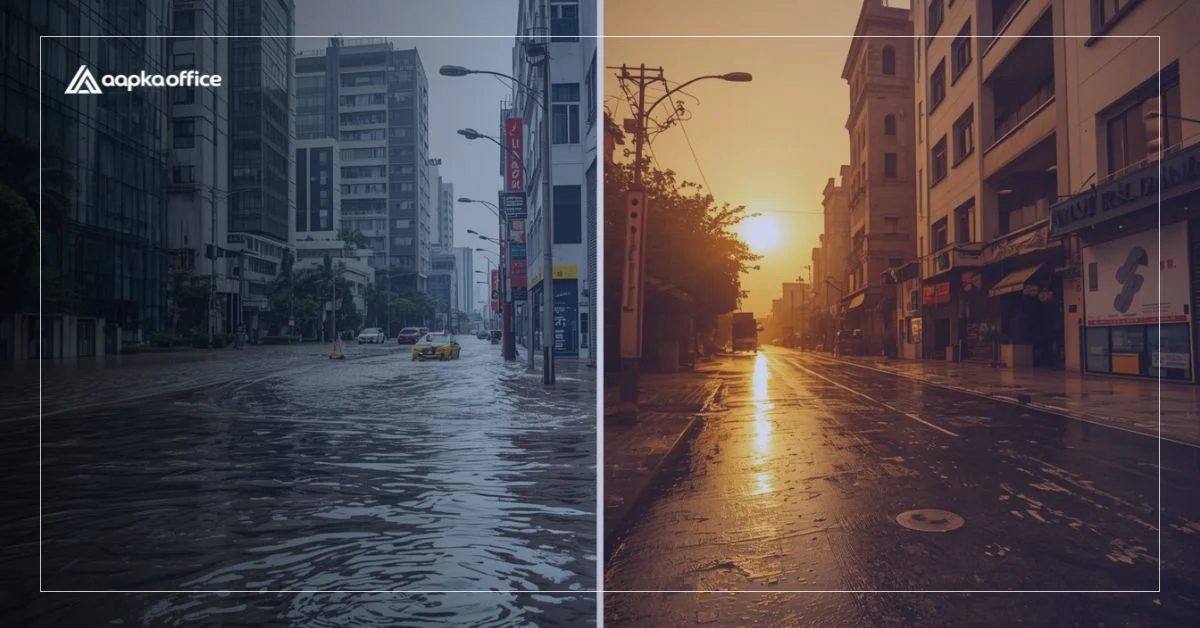
Delhi NCR has always had a challenging climate. Summers reach 45 to 48°C. Monsoon rainfall is intense and concentrated. The city’s rapid urbanisation has reduced the permeable ground surface that once absorbed rainfall and replaced it with concrete, asphalt, and compacted soil that sheds water into drainage systems designed for a different era.
What has changed in the last decade is the frequency and severity of the extremes. The Delhi floods of July 2023 — the worst in 45 years — put the Yamuna 2 metres above the danger mark, inundated significant commercial areas in Central Delhi and surrounding low-lying zones, and disrupted operations in buildings that had never flooded in living memory. Heatwave conditions that once lasted 3 to 5 days now persist for 2 to 3 weeks, pushing grid electricity demand beyond supply capacity and causing power cuts at exactly the moment when air conditioning demand is highest.
For businesses occupying commercial buildings in Delhi NCR, these are no longer theoretical risks. They are operational risks that have materialised, will materialise again, and are increasing in frequency and severity.
The question for commercial tenants is specific: does the building they are leasing have the physical characteristics to remain operable during the extreme weather events that Delhi NCR’s climate will deliver with increasing regularity? And if the building fails — if it floods, if the power cuts during a heatwave, if the HVAC system cannot maintain safe working temperatures — what are the tenant’s rights and what can be done to mitigate the disruption?
This guide covers the flood and heatwave risk landscape in Delhi NCR, the specific building features that determine resilience, what tenants should evaluate before leasing, and the lease and operational provisions that protect businesses when climate extremes affect building operability.
1. The Flood Risk Landscape in Delhi NCR
The Geography of Flood Risk
Delhi NCR’s flood risk is geographically specific — not all areas are equally exposed. Understanding the risk geography is the first step in any commercial real estate flood assessment.
The Yamuna floodplain:
The most acute flood risk in Delhi NCR is in the Yamuna’s active and historical floodplain — the land adjacent to the river that was, until recent decades, undeveloped or lightly developed. As commercial and residential development expanded into this zone, it created building stock that is directly exposed to high-water events.
Commercial areas in the floodplain or close to it include: parts of the ITO and IP Estate commercial corridor, portions of Central Delhi’s low-lying commercial zones, and certain industrial areas near the Yamuna.
The drainage infrastructure failure zones:
Beyond the immediate floodplain, the more widespread urban flooding risk in Delhi NCR comes from drainage infrastructure failure — stormwater systems that cannot handle the peak intensity of monsoon rainfall, causing surface water accumulation in low-lying areas that may be kilometres from any natural watercourse.
Areas particularly vulnerable to drainage failure flooding:
- Underpasses and subway areas that receive runoff from elevated roads
- Low-lying commercial areas in older Delhi colonies where the drainage infrastructure was built for a smaller population
- Industrial areas in Noida and Ghaziabad where the stormwater network is inadequate for the built density
The differential risk by property type:
Basement and ground floor space: Highest flood risk — in a drainage failure event, basement spaces can inundate rapidly. Ground floor spaces in low-lying areas face similar risk.
Upper floor office space (3rd floor and above): Minimal direct flood risk in all but catastrophic flood events. The primary risk is operational disruption — inability to reach the office if the surrounding roads are flooded — rather than direct inundation.
Industrial and warehouse space: Typically on ground level, with external yards that collect water. Risk is both inundation and damage to goods stored at floor level.
The 2023 Delhi Flood — What It Revealed About Commercial Building Resilience
The July 2023 Delhi floods provided the most comprehensive recent evidence of which building types and locations are resilient and which are not.
Key findings from the 2023 event:
Buildings in the ITO and IP Estate corridor that had electrical and HVAC infrastructure in basements suffered significant damage — basement flooding destroyed switchgear, UPS systems, and generator fuel storage that took weeks to repair.
Buildings with above-ground electrical distribution (with main switchgear on upper floors rather than basements) continued operating or resumed operations within 24 to 48 hours of floodwater receding.
Buildings with automatic water pumping systems and flood barriers at basement entrances contained flooding to manageable levels. Buildings without these measures were more severely affected.
Businesses whose server room and critical IT infrastructure was on the ground floor of low-lying buildings suffered data and hardware losses. Businesses with server rooms on upper floors or in flood-protected spaces did not.
Flood Mitigation Features — What to Look For in a Commercial Building
Feature 1 — Electrical infrastructure location:
The most critical single factor in a building’s flood resilience is where the primary electrical infrastructure is located. Buildings with main switchgear, transformer rooms, and UPS/battery rooms in basements or ground floors are significantly more vulnerable than buildings where this infrastructure is on the first floor or above.
What to verify:
- Where is the main LT (low tension) panel for the building?
- Where is the DG fuel storage?
- Where are the primary UPS systems?
- Where is the building’s HVAC chiller plant?
Any of these in a basement or at-grade in a low-lying location is a flood vulnerability.
Feature 2 — Flood barrier provision:
Physical barriers at basement access points — vehicle ramps, stairwells, service entrances — prevent surface water from flowing directly into the building’s lower areas. Effective flood barriers include:
- Demountable aluminium or fibreglass flood boards at basement vehicle ramp entrances
- Automatic rising flood barriers triggered by water level sensors
- Sealed service penetrations in basement walls that prevent groundwater ingress
- Sump pumps with automatic activation and adequate capacity for the building’s basement footprint
What to verify:
Does the building have any flood barrier provision for its basement access points? Has it been tested? What is the activation procedure — manual or automatic?
Feature 3 — Drainage capacity and backup:
Buildings in areas with inadequate external drainage rely on their own drainage systems to manage stormwater from the roof and immediate surroundings. Inadequately sized internal drainage — particularly roof drainage that cannot handle intense rainfall — can cause internal flooding from overflow rather than external inundation.
What to verify:
When did the building last experience stormwater overflow? Is there CCTV footage of the building’s surroundings during the July 2023 flood event? What is the building’s drainage capacity rating compared to the peak rainfall intensity for Delhi (approximately 100 mm per hour in extreme events)?
Feature 4 — Business continuity for flood events:
Beyond the physical building, a resilient building has a documented flood response plan:
- A designated flood warden with a specific role
- A procedure for advance warning based on IMD alerts and Yamuna level monitoring
- An equipment and document protection procedure for at-risk items
- A communication plan for tenants about building status during and after an event
What to ask:
Does the building management have a documented monsoon preparedness plan? What was the building’s response during the 2023 monsoon season?
2. The Heatwave Risk Landscape in Delhi NCR
The Scale of the Problem
Delhi NCR’s heatwave risk is less visually dramatic than flooding but more consistently operationally disruptive. The 2024 summer saw temperatures exceeding 50°C in some NCR locations — a heat intensity that creates multiple simultaneous challenges for commercial building operations.
The four operational challenges of extreme heat:
Grid electricity demand surge and supply failure: As temperatures rise above 44 to 46°C, air conditioning load across the NCR grid increases sharply. Grid demand peaks typically coincide with the hottest afternoon hours. Grid operators respond with load shedding — scheduled and unscheduled power cuts — that can last 2 to 6 hours per day in residential areas and 30 minutes to 2 hours in commercial areas during severe events.
HVAC equipment thermal stress: Air-cooled HVAC systems (the dominant type in NCR’s commercial buildings) reject heat to the outdoor air. As outdoor air temperature rises above 40°C, the efficiency of air-cooled chillers and packaged units declines significantly — a chiller designed for 42°C ambient may be running at 60 to 70% efficiency at 47°C, requiring more energy to produce the same cooling.
Wet-bulb temperature and occupant health: At extreme heat and humidity combinations, the wet-bulb temperature — the effective temperature felt by the human body — can reach levels that cause heat stress even for people sitting still indoors if the HVAC fails. For workers performing physical tasks — warehouse staff, maintenance workers — outdoor heat above 44°C creates genuine health and safety risks.
Equipment thermal management: IT equipment, servers, and sensitive analytical instruments have maximum operating temperatures. If building HVAC fails during a heatwave and server room temperatures rise above 25 to 30°C, equipment throttles performance or shuts down automatically. Extended exposure above 35°C causes hardware damage.
Heatwave Mitigation Features — What to Look For
Feature 1 — HVAC capacity margin and redundancy:
A building’s HVAC system designed for peak summer cooling should have a design margin — the ratio of installed capacity to maximum demand. In NCR’s commercial market, many buildings were designed with a 10 to 15% capacity margin above the expected peak. This margin is adequate under normal summer conditions but is consumed during extreme heat events.
What adequate looks like:
A 20 to 25% capacity margin above the expected peak load — meaning the HVAC system can still cool the building to an acceptable temperature when ambient is 5°C above the design temperature.
N+1 redundancy for critical cooling components — if one chiller fails, the remaining chillers can maintain the building at a reduced but acceptable temperature.
What to verify:
What is the building’s HVAC design temperature — the ambient temperature at which the system is sized to maintain the designed indoor temperature? For Delhi NCR, a well-designed building should have a design temperature of 44 to 46°C, not 40°C (which is the typical comfort-level design temperature that proved inadequate during 2024’s 50°C peaks).
Feature 2 — DG backup power adequacy for full HVAC load:
In most NCR commercial buildings, the DG backup is sized to maintain essential services — lifts, emergency lighting, basic electrical — but not the full HVAC load. A grid outage during a 47°C heatwave with partial DG backup means the HVAC runs at reduced capacity, and office temperatures quickly rise toward unsafe levels.
What adequate looks like:
DG backup capacity covering 100% of the building’s HVAC load, not just essential services. In practice, this means a building with 2 MW of total HVAC load should have at least 2 MW of DG capacity committed to HVAC — which is unusual in standard NCR commercial buildings.
A more practical standard: DG backup covering at least 70% of the HVAC load, with a documented load prioritisation plan that maintains server rooms, trading floors, and occupied workstation areas at HVAC temperature while reducing HVAC to lower-priority common areas (corridors, storage, parking).
What to verify:
Total DG capacity versus total HVAC load. What is covered under DG backup — is the HVAC explicitly included? What is the building management’s load shedding protocol if DG capacity is insufficient?
Feature 3 — Building envelope thermal performance:
The building envelope — walls, roof, and glazing — determines how much heat enters the building from the outside. A poorly insulated building with high solar gain requires significantly more cooling to maintain acceptable indoor temperatures. A well-insulated building with low-E glazing and a reflective roof requires less.
Key metrics:
- Window-to-wall ratio: Buildings with high glazing ratios (above 60%) facing west and south are significantly more heat-intensive to cool than buildings with lower glazing ratios or with external shading devices
- Glazing specification: Low-emissivity (Low-E) glass with a solar heat gain coefficient (SHGC) below 0.3 is significantly better than standard double-glazed units with SHGC above 0.5
- Roof specification: A white or reflective roof reduces solar heat gain by 20 to 40% compared to a dark-coloured or uninsulated roof
- External shading: Fixed or adjustable shading devices on south and west-facing facades reduce solar heat gain significantly
What to verify:
Request the building’s energy audit or performance certificate — this should include the SHGC of the glazing and the roof thermal specification. Alternatively, assess the building’s cooling load from the HVAC specification — a high-quality thermally efficient building envelope reduces the cooling load per sq ft significantly.
Feature 4 — Server Room and Critical IT Area Redundant Cooling:
For technology tenants, the server room cooling system is the most critical HVAC element. A server room temperature above 30°C begins to risk hardware damage and automatic equipment shutdown.
What adequate looks like:
Dedicated precision cooling for the server room — independent of the building’s main HVAC system — with its own backup power. The precision cooling system should maintain the server room below 25°C even if the building’s main HVAC fails completely.
What to verify:
Is there dedicated cooling for the server room or is it dependent on the building’s main HVAC? Does the server room cooling have its own backup power? What is the server room’s maximum temperature tolerance if the cooling fails — and how long before critical temperature is reached?
Feature 5 — Indoor Environment Monitoring and Early Warning:
A building with real-time temperature monitoring in occupied areas — connected to an alerting system that notifies the building management when temperatures approach threshold levels — can activate contingency measures before conditions become unsafe.
What adequate looks like:
Temperature and humidity sensors in all occupied areas with alerts at 28°C and emergency alerts at 32°C (above which prolonged occupancy creates health risk for sedentary office workers, and above which most electronic equipment begins to show thermal stress).
3. The Building Assessment Framework — Pre-Lease Checklist
Before signing a commercial lease in Delhi NCR, assess the building against these specific resilience parameters.
Flood resilience checklist:
| Parameter | Minimum Acceptable | Premium Standard | How to Verify |
| Electrical infrastructure location | Ground floor and above | 2nd floor and above | Physical inspection of electrical room location |
| Basement flood barriers | At vehicle ramp entry | All access points, auto-activation | Physical inspection, test demonstration |
| Drainage capacity | Adequate for historical events | Designed for 100mm/hr peak | Building engineer specification |
| Sump pumps | Manual activation | Auto-activation, adequate capacity | Technical specification |
| DG fuel storage location | Above ground | Above 1st floor in flood risk zones | Physical inspection |
| Flood response plan | Basic procedures | Documented plan with IMD alert integration | Document review |
Heatwave resilience checklist:
| Parameter | Minimum Acceptable | Premium Standard | How to Verify |
| HVAC design temperature | 42°C ambient | 46°C ambient | HVAC specification sheet |
| HVAC capacity margin | 10–15% above peak load | 20–25% above peak load | Chiller capacity vs building cooling load |
| DG backup for HVAC | 50% of HVAC load | 100% of HVAC load | DG capacity vs HVAC load documentation |
| Server room dedicated cooling | Dependent on main HVAC | Independent precision cooling with backup | Physical inspection and specification |
| Building envelope SHGC | Below 0.4 | Below 0.25 | Glazing specification document |
| Temperature monitoring | Manual checks | Real-time sensors with auto-alerts | Building management system demo |
4. The Most Resilient Commercial Locations in Delhi NCR — and the Most Vulnerable
Highest flood risk commercial locations (avoid or assess very carefully):
- Basement offices anywhere in the ITO, IP Estate, and Central Delhi commercial corridor near the Yamuna
- Ground floor units in areas below the 200m elevation contour in North Delhi and East Delhi
- Industrial and warehouse premises in low-lying areas near the Hindon river in Ghaziabad
- Commercial premises in areas that flooded in July 2023 — check historical flood mapping from NDMA or Delhi Urban Flood Risk Assessment
Lowest flood risk commercial locations (structurally advantaged):
- Upper floors (3rd and above) in institutional Grade A towers in Cyber City, Golf Course Road, and the Noida Expressway — these locations have minimal direct flood exposure and the buildings have above-grade electrical infrastructure
- Commercial premises in Gurugram’s GCER and Udyog Vihar belt — the drainage infrastructure is modern and the terrain does not collect water in the way Central Delhi’s older areas do
- Newly developed commercial parks in Greater Noida — built to modern drainage standards on relatively elevated terrain
Highest heatwave operational risk:
- Buildings with west-facing high glazing ratios in any corridor — afternoon heat gain is most severe on west-facing facades and is a design deficiency that cannot be fully corrected by HVAC
- Buildings where the DG backup has never been tested under full summer load — the HVAC system is not included in the backup scope or the DG fuel capacity is insufficient for extended operation
- Industrial sheds with uninsulated metal roofs — these become extremely hot in summer, with internal temperatures approaching or exceeding ambient outdoor temperatures when the ventilation and cooling is inadequate
Best heatwave performance:
- LEED Gold and Platinum certified buildings — the energy performance requirements of LEED certification have driven investment in building envelope quality and HVAC efficiency that directly improves heatwave resilience
- Buildings with chilled water HVAC systems (rather than direct expansion systems) — chilled water systems have better capacity scaling under high ambient conditions
- Buildings completed after 2018 that incorporated the revised national building code’s energy efficiency requirements — including improved minimum insulation standards
5. The Lease Provisions That Protect Tenants
The physical building resilience reduces the probability and severity of climate disruption. Lease provisions manage the financial and operational consequence when disruption occurs despite the building’s resilience measures.
Provision 1 — Force Majeure Definition That Includes Extreme Weather:
Standard commercial leases include a force majeure clause that suspends the tenant’s rent obligation if an extraordinary event prevents occupation. However, most force majeure clauses are drafted narrowly — covering Acts of God, war, or government action — without specifically addressing extreme weather events.
Draft language:
“Force Majeure Events shall include, without limitation, floods, heatwaves causing building temperatures to exceed safe working conditions as defined by applicable workplace safety standards, power grid failures lasting more than [8] hours during which the Landlord is unable to maintain building services, and any other extreme weather event declared by the relevant government authority as a public health or safety emergency.”
Provision 2 — Temperature-Based Right to Vacate:
A specific clause that addresses the heatwave scenario — the building is physically undamaged but is operationally unusable because the HVAC cannot maintain safe working temperatures.
Draft language:
“In the event that the indoor temperature within the Demised Premises exceeds [30°C] for a continuous period of [4] hours during Business Hours due to HVAC failure or power grid outage, the Tenant shall be entitled to close the Premises and shall not be in breach of any obligation to occupy during the affected period. The Landlord shall use reasonable endeavours to restore HVAC functionality as soon as practicable. If indoor temperatures exceed [30°C] for more than [12] cumulative hours in any calendar month, the Tenant shall be entitled to a rent credit of [1 day’s rent per additional 4-hour period of non-compliance].”
Provision 3 — Flood Damage Responsibility:
Clarity about who is responsible for damage to the tenant’s fit-out and equipment if the building floods — this is frequently a disputed question in standard lease language.
Draft language:
“In the event of flooding within the Demised Premises caused by the Landlord’s failure to maintain the building’s drainage, flood barrier, or waterproofing systems in operational condition, the Landlord shall bear responsibility for repair of the building structure and base-build fit-out. Damage to the Tenant’s property, equipment, and tenant fit-out caused by such flooding shall be covered by the Tenant’s occupier’s liability insurance. The Landlord shall maintain adequate flood insurance for the building structure.”
Provision 4 — Business Continuity Infrastructure Commitment:
A specific commitment from the Landlord that the building’s business continuity infrastructure — DG backup, flood barriers, sump pumps — will be maintained in operational condition throughout the lease term.
Draft language:
“The Landlord warrants that the following business continuity infrastructure will be maintained in operational condition throughout the Lease Term: (a) Diesel Generator backup providing [X] kW of power covering lifts, emergency lighting, and [specify HVAC coverage]; (b) Flood barriers at basement access points [if applicable]; (c) Sump pumps with [X] litres per minute pumping capacity at all basement low points. The Landlord shall conduct quarterly tests of the DG backup and annual tests of flood barriers and sump pumps, with test records available to the Tenant on request.”
6. The Operational Resilience Measures Tenants Control Independently
Not all resilience measures require the landlord’s cooperation. Several operational measures are within the tenant’s direct control — regardless of the building’s base specification.
Flood operational measures:
Elevate sensitive equipment: Server racks, UPS systems, and critical workstations should be on raised platforms or above-ground floors rather than at floor level. A 15 cm raised platform for a server rack costs ₹8,000 to ₹15,000 and protects against shallow inundation that would otherwise damage floor-level equipment.
Critical document and data backup: Maintain current offsite or cloud backup of all critical data and documents. A monsoon flood that reaches a server room is a data loss event if the backup is not current. Cloud backup that is continuously updated and independently located from the physical server is the only reliable protection.
Insurance: Tenant’s occupier liability insurance should specifically include flood damage as a named peril. Many standard policies exclude flooding — verify the policy’s flood coverage explicitly, including whether it covers both surface water flooding and rising groundwater.
Emergency response protocol: A documented internal procedure for the monsoon season — who monitors IMD warnings, who activates the flood response, who removes at-risk equipment, who communicates with the team about building closure — reduces decision-making time when an event is occurring.
Heatwave operational measures:
Supplemental cooling for server rooms: A dedicated portable precision air conditioner (1 to 3 tonne capacity) specifically for the server room, with its own backup power — costing ₹1.5 to ₹4 lakh — provides the server room with independent cooling that is not dependent on the building’s main HVAC. The single most cost-effective resilience investment for any technology tenant.
Personal cooling devices for emergency periods: Portable fans, personal cooling devices, and access to cool water maintained in the office for use if the HVAC fails temporarily during a heatwave. These do not provide thermal comfort at 48°C ambient — but they bridge a 2 to 4 hour HVAC outage at the margin.
Adjusted working hours policy: A pre-approved work-from-home policy that is activated when the weather index exceeds specific thresholds — so the team can shift to remote work on days when the building’s thermal environment is significantly degraded. This requires a pre-approved organisational protocol, not a crisis-time decision.
Modified power schedule: Shifting high-power computing workloads (data processing, model training, rendering) to off-peak hours (11 PM to 7 AM) during heatwave periods reduces the in-building thermal load and reduces the demand on the HVAC system during the hottest afternoon hours.
7. What Is Coming — The Regulatory and Market Response
India’s commercial building sector is beginning to respond to the escalating climate risk through both regulatory and market mechanisms.
The National Building Code 2016 and energy performance standards:
The National Building Code 2016 introduced mandatory energy performance standards for commercial buildings — including requirements for building envelope thermal performance, HVAC efficiency, and lighting. Buildings permitted after 2016 in states that have adopted the NBC are required to meet these standards, which address some of the heatwave vulnerability of older building stock.
However, compliance verification and enforcement remain uneven — a building with a 2016 building plan approval may have been designed to NBC standards without rigorous verification of actual construction quality.
ECBC (Energy Conservation Building Code):
The Bureau of Energy Efficiency’s ECBC sets specific performance standards for commercial buildings above 500 sq m. ECBC compliance is mandatory in several states and is increasingly being required by institutional developers as part of their standard specification. ECBC buildings have better thermal envelopes and more efficient HVAC systems than pre-ECBC buildings — which translates directly into heatwave resilience.
Flood Risk Disclosure:
There is currently no mandatory flood risk disclosure requirement for commercial properties in India — a gap that is increasingly apparent given the 2023 floods. RERA requires disclosure of certain property information, but flood risk is not specifically mandated.
Some institutional developers are beginning to voluntarily include flood risk assessments in their building documentation — both as a quality signal and as a response to institutional investors’ ESG due diligence requirements.
What Climate Resilience Means for Lease Decisions in 2026
The commercial buildings that will maintain their occupancy and rent levels through the increasing frequency of extreme weather events in Delhi NCR are the buildings that have invested in resilience infrastructure — flood barriers, above-grade electrical, DG backup for HVAC, good building envelopes, and documented emergency response plans.
The buildings that have not made these investments are buildings whose tenants will experience disruption, whose fit-out and equipment will be damaged in flood years, and whose HVAC will fail to maintain safe working conditions during the most severe summer heat. The operational cost of this disruption — lost productivity, data recovery, equipment replacement, and staff welfare concerns — is real and is not captured in the rent-per-sq-ft comparison that most lease decisions rely on.
For tenants signing commercial leases in Delhi NCR in 2026 and beyond, asking the climate resilience questions — explicitly, before signing, with the specificity described in this guide — is not alarmism. It is the application of basic due diligence to a set of operational risks that have demonstrably materialised in the recent past and will materialise again.
The cost of asking these questions is 2 to 4 additional hours of due diligence. The cost of not asking them is exposure to the next July 2023 — or the next June 2024 heatwave — in a building that was not designed or managed for the climate it now faces.