
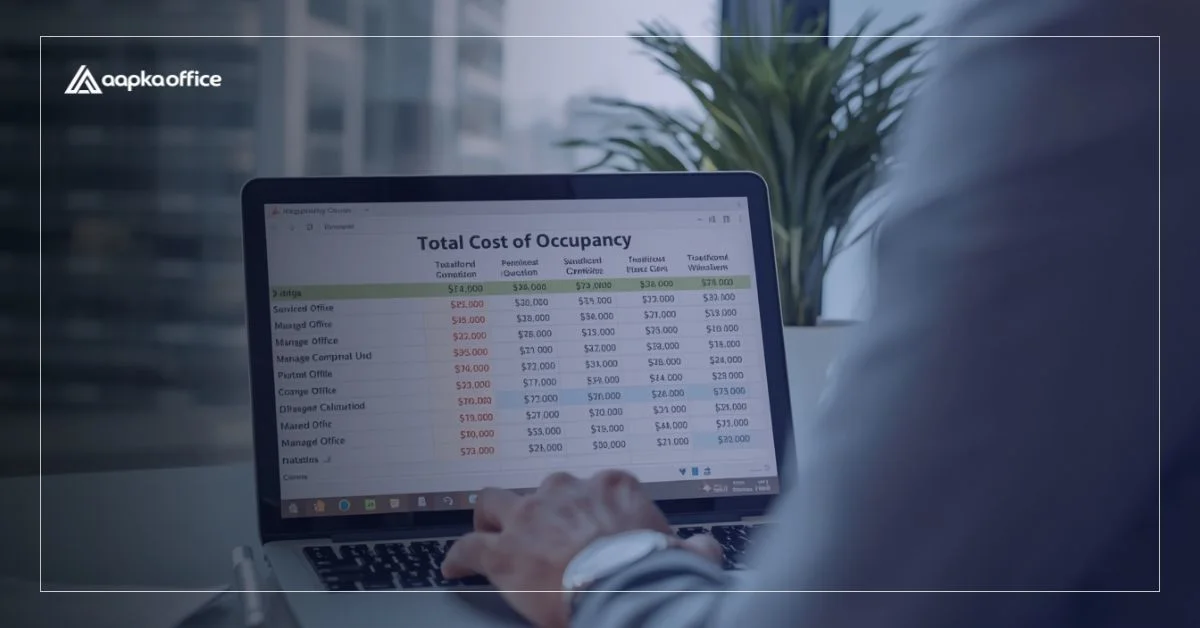
Every conversation about office occupancy models eventually comes down to the same argument: the managed office is more expensive per sq ft than a traditional lease.
This argument is both technically correct and practically misleading.
A traditional lease at ₹80 per sq ft per month does look cheaper than a managed office at ₹12,000 per seat per month (approximately ₹120 to ₹150 per sq ft at standard density). But the traditional lease at ₹80 per sq ft does not include the fit-out that costs ₹1,500 per sq ft to install, the deposit that ties up 5 months of rent in a non-interest-bearing account, the CAM charges that add ₹20 per sq ft per month, the property tax and utility management overhead, the facility management cost, the internet infrastructure the tenant must independently procure and manage, or the financial exposure of a 3-year lock-in on a space whose utilisation may drop by 30% in Month 18 if the business restructures.
The managed office at ₹12,000 per seat includes most of these. The traditional lease at ₹80 per sq ft includes almost none.
Total cost of occupancy — the full financial cost of occupying a specific office space including every direct and indirect component — is the only metric that allows a genuine comparison between occupancy models. And in most cases, when the TCO is calculated correctly for the specific company’s circumstances, the “more expensive” managed office is in the same range as or cheaper than the “cheaper” traditional lease — and the serviced office falls at a specific point in the range depending on the company’s size, growth trajectory, and risk tolerance.
This guide builds three specific case studies — one for each occupancy model — using a consistent company profile in Gurugram’s commercial market. Each case study calculates the complete 3-year and 5-year TCO, the break-even points, and the specific circumstances under which each model is the economically superior choice.
1. The Three Models — Defined Precisely
Before the numbers, the definitions. The three terms are used interchangeably in the Indian market — incorrectly.
Model A — Serviced Office
What it is: A workstation or small private cabin in a shared building where multiple companies coexist. The operator provides fully furnished, staffed, and equipped workstations — typically at a per-seat per-month price. Most suitable for 1 to 15 person teams.
Key characteristics:
- Fully furnished: desk, chair, storage included
- Shared amenities: reception, meeting rooms, kitchen
- Flexible tenure: monthly commitments common
- All-in pricing: internet, HVAC, utilities, cleaning included
- No fit-out required
- No long-term commitment required
Typical price range in Gurugram (2025): ₹8,000 to ₹16,000 per seat per month
Model B — Managed Office (Private Suite)
What it is: A dedicated, private, fully fitted and managed office suite for a company — with its own entrance, its own branding space, and its own operational control — within a building operated by a managed office provider. The suite is customised for the specific tenant. Suitable for 15 to 300 seats.
Key characteristics:
- Fully private — no shared workstation space
- Brand-able — company signage, dedicated reception
- Fully fitted and managed — furniture, internet, HVAC, cleaning, security included
- Longer tenure: 12 to 36 month commitments standard
- No fit-out investment required
- Operator manages all building services
Typical price range in Gurugram (2025): ₹10,000 to ₹22,000 per seat per month
Model C — Traditional Lease (Conventional Lease)
What it is: A direct lease of bare shell or warm shell commercial space from a building owner, on a conventional registered lease deed. The tenant fits out the space, manages their own operations, and occupies it exclusively for the lease term.
Key characteristics:
- Fully private and self-managed
- Bare or warm shell — tenant provides own fit-out
- All services separately procured: internet, HVAC, cleaning, security
- Long-term commitment: 3 to 5 year leases with lock-ins
- High upfront investment: fit-out, deposit, registration costs
- Full operational overhead: facility management, vendor management, lease administration
Typical price range in Gurugram (2025):
- Grade A (Cyber City): ₹130 to ₹175 per sq ft per month
- Grade A (Golf Course Road): ₹110 to ₹145 per sq ft per month
- Grade B (GCER): ₹55 to ₹85 per sq ft per month
2. The TCO Framework — Every Cost Component
Total cost of occupancy must include every component that varies between models. This is the complete list:
Direct occupancy costs:
- Monthly rent or seat fee
- CAM (Common Area Maintenance) charges
- Electricity and utilities
- Property tax (sometimes passed through in CAM)
- GST on rent (18% — ITC-recoverable for GST-registered businesses)
Upfront costs (amortised over lease term):
- Fit-out cost (furniture, electrical, HVAC, IT, flooring, partitions)
- Security deposit (opportunity cost at 12% per annum if deposited in non-interest-bearing account)
- Registration and stamp duty cost
- Relocation cost
Operational overhead (indirect costs):
- Internet and connectivity infrastructure and management
- Facility management (cleaning, security, maintenance)
- Vendor management overhead (time cost of managing multiple service vendors)
- Lease administration (compliance, renewals, regulatory filings)
Risk cost:
- Lock-in exposure (monthly rent × remaining lock-in months if forced to exit)
- Fit-out write-off cost if forced to exit before payback
3. The Case Study Company Profile
To make the TCO comparison specific and comparable, all three models are evaluated for the same company:
Company Profile:
- Technology services company
- Current headcount: 50 people
- Projected headcount at Year 3: 65 to 75 people (moderate growth scenario)
- Location: Gurugram (Golf Course Road / GCER target corridor)
- Business profile: B2B SaaS company, 4 years old, Series A funded
- GST registration: Yes — can claim ITC on rent
- Financial position: ₹3 crore annual revenue, ₹60 lakh cash available for workplace investment
- Lease decision: The lease on their current managed office expires in 90 days. Decision required now.
Standard assumptions:
- Working space density: 100 sq ft per seat (standard office density)
- 50 seats at 100 sq ft = 5,000 sq ft required
- Analysis period: 3 years (Year 1 to Year 3) and 5 years (Year 1 to Year 5)
- Opportunity cost of capital: 12% per annum (applied to deposits and fit-out investment)
4. Model A: Serviced Office — The Complete TCO
Configuration: 50 seats in a shared serviced office space in Gurugram’s GCER belt.
Monthly costs:
| Cost Component | Per Seat | Total Monthly |
| Seat fee (all-inclusive) | ₹9,500 | ₹4,75,000 |
| GST at 18% | ₹1,710 | ₹85,500 |
| Less: ITC recovery | -₹1,710 | -₹85,500 |
| Net monthly cost | ₹9,500 | ₹4,75,000 |
Note: ITC-registered businesses can claim back the 18% GST paid on rent, making the net cost the pre-GST figure.
Upfront costs:
| Cost Component | Amount |
| Security deposit (3 months typical) | ₹14,25,000 |
| Opportunity cost of deposit at 12% p.a. | ₹1,71,000/year |
| Fit-out cost | Nil — included |
| Registration cost | Nil — licence agreement |
| Relocation cost | ₹1,00,000 (minimal — no fit-out to move) |
Year 1 Total Cost:
| Component | Amount |
| Monthly seat fee × 12 | ₹57,00,000 |
| Opportunity cost of deposit | ₹1,71,000 |
| Relocation | ₹1,00,000 |
| Year 1 TCO | ₹59,71,000 |
Year 3 Total Cost (assuming 8% seat fee escalation at Month 13 and Month 25):
| Year | Monthly Cost | Annual Cost |
| Year 1 | ₹4,75,000 | ₹57,00,000 |
| Year 2 | ₹5,13,000 | ₹61,56,000 |
| Year 3 | ₹5,54,040 | ₹66,48,480 |
| 3-Year total | ₹1,85,04,480 |
Plus deposit opportunity cost for 3 years: ₹5,13,000 3-Year TCO: ₹1,90,17,480
Year 5 Total Cost:
| Year | Annual Cost |
| Year 4 | ₹71,80,198 |
| Year 5 | ₹77,54,614 |
| Years 1-5 total | ₹3,34,39,292 |
Plus deposit opportunity cost for 5 years: ₹8,55,000 5-Year TCO: ₹3,42,94,292
Advantages of serviced office model for this company:
- Zero capital deployment for fit-out — preserves the ₹60 lakh cash for product and hiring
- Flexibility to exit with 30 to 60 days notice if headcount changes
- No lock-in exposure
- Fully managed — no facility vendor management overhead
Disadvantages:
- Highest per-seat cost that escalates with the operator’s pricing rather than at a negotiated escalation rate
- Limited ability to brand the space or create a distinctive company culture environment
- Shared amenities may not meet the standards required for client meetings at scale
- Space may not be available at the same location if headcount grows significantly
5. Model B: Managed Office (Private Suite) — The Complete TCO
Configuration: 50-seat private managed office suite in a GCER Grade B building operated by a managed office provider.
Monthly costs:
| Cost Component | Per Seat | Total Monthly |
| Seat fee (fully managed private suite) | ₹11,500 | ₹5,75,000 |
| GST at 18% | ₹2,070 | ₹1,03,500 |
| Less: ITC recovery | -₹2,070 | -₹1,03,500 |
| Net monthly cost | ₹11,500 | ₹5,75,000 |
Upfront costs:
| Cost Component | Amount |
| Security deposit (2 to 3 months) | ₹11,50,000 to ₹17,25,000 (assume ₹17,25,000 at 3 months) |
| Opportunity cost of deposit at 12% p.a. | ₹2,07,000/year |
| Fit-out cost | Nil — furnished suite included |
| Registration cost | Minimal — licence agreement or short-term lease |
| Relocation cost | ₹2,00,000 (IT setup, minor customisation) |
| Initial branding and customisation | ₹1,50,000 |
Year 1 Total Cost:
| Component | Amount |
| Monthly seat fee × 12 | ₹69,00,000 |
| Opportunity cost of deposit | ₹2,07,000 |
| Relocation and setup | ₹3,50,000 |
| Year 1 TCO | ₹74,57,000 |
Year 3 Total Cost (assuming 10% escalation at Month 13, negotiated rather than standard 15%):
| Year | Monthly Cost | Annual Cost |
| Year 1 | ₹5,75,000 | ₹69,00,000 |
| Year 2 | ₹6,32,500 | ₹75,90,000 |
| Year 3 | ₹6,95,750 | ₹83,49,000 |
| 3-Year total | ₹2,28,39,000 |
Plus deposit opportunity cost for 3 years: ₹6,21,000 Plus setup costs: ₹3,50,000 3-Year TCO: ₹2,38,10,000
Year 5 Total Cost:
| Year | Annual Cost |
| Year 4 | ₹90,12,720 |
| Year 5 | ₹99,13,992 |
| Years 1-5 total | ₹5,00,13,712 |
Deposit opportunity cost 5 years: ₹10,35,000 5-Year TCO: ₹5,10,48,712
Advantages of managed office model for this company:
- Private, fully branded suite — employer brand signal and client meeting capability
- Full services included — no facility management overhead
- No fit-out capital deployment
- Moderate flexibility — typically 12 to 24 month commitments with break clauses negotiable
- Easier to expand if headcount grows — most managed office operators can accommodate additional seats
Disadvantages:
- Highest absolute monthly cost of the three models at this scale (50 seats)
- Less financial control than a conventional lease — subject to operator’s pricing changes at renewal
- Operator business risk — if the operator exits the market, the tenant must relocate
6. Model C: Traditional Lease — The Complete TCO
Configuration: 5,000 sq ft conventional lease of Grade B bare shell space in GCER, Gurugram.
Monthly rent costs:
| Cost Component | Per sq ft | Total Monthly |
| Rent (negotiated) | ₹72 | ₹3,60,000 |
| CAM charges | ₹15 | ₹75,000 |
| Electricity (estimated) | ₹12 | ₹60,000 |
| GST at 18% on rent | ₹12.96 | ₹64,800 |
| Less: ITC on GST | -₹12.96 | -₹64,800 |
| Net monthly recurring | ₹4,35,000 |
Upfront costs:
| Cost Component | Amount | Amortised over 3 years |
| Fit-out at ₹1,400/sq ft (complete fit-out) | ₹70,00,000 | ₹23,33,333/year |
| Security deposit (5 months × ₹3,60,000) | ₹18,00,000 | — |
| Opportunity cost of deposit at 12% | ₹2,16,000/year | ₹2,16,000/year |
| Stamp duty and registration (Haryana, 5-year lease) | ₹4,50,000 | ₹1,50,000/year |
| Relocation and move cost | ₹3,00,000 | ₹1,00,000/year |
| Internet and IT infrastructure setup | ₹3,50,000 | ₹1,16,667/year |
| Facility management services (cleaning, security) | ₹40,000/month | ₹4,80,000/year |
| Lease management admin overhead | ₹15,000/month est. | ₹1,80,000/year |
Year 1 Total Cost (including fit-out amortisation):
| Component | Annual Amount |
| Net annual rent | ₹43,20,000 |
| CAM annual | ₹9,00,000 |
| Annual electricity | ₹7,20,000 |
| Fit-out amortisation (over 3 years) | ₹23,33,333 |
| Deposit opportunity cost | ₹2,16,000 |
| Stamp duty amortised | ₹1,50,000 |
| Relocation amortised | ₹1,00,000 |
| IT infrastructure amortised | ₹1,16,667 |
| Facility management services | ₹4,80,000 |
| Lease admin overhead | ₹1,80,000 |
| Year 1 TCO | ₹95,15,000 |
Year 3 Total Cost (with 10% escalation at Year 2, fit-out fully amortised):
| Year | Recurring Costs | Fit-out Amortisation | Total Annual |
| Year 1 | ₹67,16,000 | ₹23,33,333 | ₹90,49,333* |
| Year 2 | ₹72,89,400 | ₹23,33,333 | ₹96,22,733* |
| Year 3 | ₹72,89,400 | ₹23,33,333 | ₹96,22,733* |
*Note: Year 1 setup and registration costs adjust the Year 1 figure.
3-Year TCO (total cash outflow including fit-out):
| Component | 3-Year Total |
| Rent, CAM, utilities | ₹1,92,88,200 |
| Fit-out (cash outflow in Year 1) | ₹70,00,000 |
| Deposit (tied capital, not cash cost but opportunity cost) | ₹6,48,000 (OC at 12% × 3 years) |
| Stamp duty and registration | ₹4,50,000 |
| IT infrastructure | ₹3,50,000 |
| Relocation | ₹3,00,000 |
| Facility management (3 years) | ₹14,40,000 |
| Lease admin overhead (3 years) | ₹5,40,000 |
| 3-Year TCO (total cash) | ₹3,00,16,200 |
Year 5 Total Cost (lease extended or renewed, fit-out partially depreciated):
| Years | Recurring Costs (est.) | Total |
| Year 4 | ₹79,00,000 | ₹79,00,000 |
| Year 5 | ₹85,00,000 | ₹85,00,000 |
| 5-Year TCO | ₹4,64,16,200 |
7. The Side-by-Side Comparison
| TCO Component | Serviced Office | Managed Office | Traditional Lease |
| Monthly cost (Year 1) | ₹4,75,000 | ₹5,75,000 | ₹4,35,000 |
| Upfront cash required | ₹16,25,000 | ₹20,75,000 | ₹81,00,000 |
| 3-Year total TCO | ₹1,90,17,480 | ₹2,38,10,000 | ₹3,00,16,200 |
| 5-Year total TCO | ₹3,42,94,292 | ₹5,10,48,712 | ₹4,64,16,200 |
| Lock-in exposure | Nil | ₹34,50,000 (6 months) | ₹43,20,000 (12 months) |
| Headcount flexibility | High — immediate scale | Moderate — 1 to 4 weeks | Low — structural commitment |
| Employer brand capability | Low (shared space) | High (private branded) | Highest (fully owned environment) |
Reading the comparison:
Over 3 years, the serviced office is the cheapest model by a wide margin. Over 5 years, the traditional lease becomes cheaper than the managed office — but remains more expensive than the serviced office because the escalating serviced office rates in Years 4 and 5 are still lower than the traditional lease’s recurring costs plus the ongoing operational overhead.
The managed office is the most expensive model at 5 years for this company profile — the combination of higher seat fees than serviced offices and higher ongoing costs than a traditional lease that has already amortised its fit-out makes it the highest TCO option at the 5-year horizon.
8. The Break-Even Analysis — Where Each Model Crosses the Other
Serviced office vs traditional lease break-even:
At the 3-year horizon, the serviced office is ₹1,10,00,000 cheaper than the traditional lease on a total cash basis. The serviced office remains cheaper than the traditional lease on an annual basis until approximately Year 5 to Year 6 — when the traditional lease’s lower recurring costs (after fit-out amortisation) finally produce a lower annual TCO.
The break-even chart:
| Year | Cumulative Serviced | Cumulative Traditional | Cumulative Managed |
| End Year 1 | ₹59,71,000 | ₹95,15,000 | ₹74,57,000 |
| End Year 2 | ₹1,20,71,000 | ₹1,74,91,000 | ₹1,55,47,000 |
| End Year 3 | ₹1,90,17,480 | ₹2,72,88,000 | ₹2,45,03,000 |
| End Year 4 | ₹2,61,97,678 | ₹3,55,88,000 | ₹3,48,15,720 |
| End Year 5 | ₹3,42,94,292 | ₹4,44,88,000 | ₹4,55,89,712 |
Findings:
The traditional lease breaks even against the managed office at approximately Year 4 and against the serviced office at approximately Year 6 to Year 7.
The managed office never breaks even against the serviced office over a 5-year horizon at this company size and this GCER location — the managed office’s higher seat fee is not offset by any TCO advantage over the serviced office for a 50-seat team.
9. The Hidden Factor — Risk-Adjusted TCO
The pure TCO comparison above treats each model as if all three outcomes are equally certain. They are not. The traditional lease carries a financial risk that the serviced and managed office models do not:
Lock-in exit cost:
The traditional lease has a 3-year lock-in. If the company needs to exit after Year 1 — because of business contraction, funding issues, a merger, or a decision to relocate — the minimum exit cost is:
Remaining lock-in: 24 months × ₹4,35,000 = ₹1,04,40,000
Plus the write-off of unamortised fit-out: Fit-out cost ₹70,00,000 — Year 1 depreciation ₹23,33,333 = ₹46,66,667 write-off
Total worst-case exit cost at Year 1: ₹1,51,06,667
The serviced office’s worst-case exit cost at Year 1: 30 to 60 days’ notice = ₹9,50,000 to ₹19,00,000.
Risk-adjusted TCO for a company with 30% probability of needing to exit before Year 3:
| Model | 3-Year TCO | P(Exit) × Exit Cost | Risk-Adjusted 3-Year TCO |
| Serviced Office | ₹1,90,17,480 | 30% × ₹14,25,000 | ₹1,94,44,980 |
| Managed Office | ₹2,38,10,000 | 30% × ₹34,50,000 | ₹2,48,45,000 |
| Traditional Lease | ₹3,00,16,200 | 30% × ₹1,51,06,667 | ₹3,45,47,400 |
The risk adjustment significantly increases the cost differential between the traditional lease and the more flexible models — and confirms that for companies with meaningful uncertainty about their 3-year trajectory, the financial case for a traditional lease weakens substantially.
10. The Qualitative Factors — What the Numbers Cannot Capture
The TCO comparison is necessary but not sufficient. Three qualitative factors significantly affect which model is optimal for a specific company.
Factor 1 — Talent and employer brand:
The company’s workspace is a talent acquisition and retention tool. A Series A funded technology company competing for senior engineering talent needs a workspace that signals professionalism and employer commitment. A serviced office — particularly a densely packed, generic-looking shared space — may undermine the employer brand signal.
The managed office private suite, with the company’s own branding, creates a substantially better employer brand environment than a generic serviced office. The traditional lease, fully customised to the company’s brand and culture, creates the best employer brand environment of the three models — but at the highest cost.
For this 50-person company in a competitive engineering talent market, this qualitative factor likely favours the managed office over the serviced office — even though the serviced office is cheaper on a pure TCO basis.
Factor 2 — Client-facing requirements:
A B2B SaaS company with enterprise clients who visit the office for demonstrations, workshops, and business reviews needs a workspace that is appropriate for client-facing activities. A serviced office may lack private, well-equipped meeting rooms. A managed private suite provides this. A traditional lease provides it fully.
Factor 3 — Operational focus:
The traditional lease requires the company to manage its own facility — cleaning, security, maintenance, vendor contracts, lease compliance. For a 50-person technology company, this is a non-trivial overhead — estimated at ₹15,000 per month of management time across the finance and operations functions. The managed office and serviced office eliminate this overhead. The TCO model partially captures this through the “lease admin overhead” line — but the actual distraction cost to the management team is difficult to fully quantify.
11. The Decision Framework — Which Model Is Right When
The TCO analysis and risk assessment produce a clear framework for which model is optimal under which conditions:
Choose serviced office when:
- Team is below 20 seats
- The business is in the first 12 to 18 months — high uncertainty about growth trajectory
- No client-facing meeting requirements that exceed shared meeting room quality
- Preserving cash is the highest priority
- Geographic flexibility is needed — ability to move location quickly
Choose managed office when:
- Team is 20 to 100 seats
- 12 to 24 month planning horizon with moderate growth certainty
- Client-facing and employer brand requirements mandate a private, branded space
- The company cannot deploy ₹40 to ₹80 lakh in fit-out capital
- The decision-maker values operational simplicity over cost optimisation at scale
Choose traditional lease when:
- Team is above 80 to 100 seats (the TCO advantage becomes meaningful above this scale)
- 4 to 5 year planning horizon with high trajectory confidence
- The business has capital available for fit-out deployment without compromising operational needs
- The company has or can build the operational capacity to manage a conventional lease
- Employer brand and workspace customisation are strategic priorities that justify the premium investment
The 50-person company in this case study:
Based on the analysis, the managed office is the correct model for this specific company at this specific point — despite being more expensive than the serviced office in pure TCO terms. The employer brand requirement of a Series A funded technology company competing for senior engineering talent, combined with the client-facing requirements and the inability to deploy ₹70 lakh in fit-out capital without compromising the hiring plan, makes the managed office the TCO winner when qualitative factors are included in the assessment.
The traditional lease becomes the superior model at 80 to 100 seats, when the per-seat TCO advantage of the conventional lease at scale outweighs the higher fit-out investment, and when the company has sufficient trajectory confidence to commit to a 3 to 5 year lock-in without significant risk exposure.
The serviced office remains the right model for the team that is below 20 seats, pre-product-market fit, or genuinely uncertain about whether they will be 30 or 80 people in 24 months.
12. What This Means for the Lease Decision
The TCO framework produces a specific, actionable conclusion: the choice between occupancy models is a financial modelling exercise, not an intuitive judgement about which option looks cheaper.
Before any company commits to an occupancy model, they should complete the TCO calculation for their specific size, location, growth scenario, and risk tolerance — using the structure in this guide — and then apply the qualitative overlay of employer brand, client-facing requirements, and operational capacity.
The company that does this work and presents the completed analysis to their board or leadership team has made a real estate decision rather than a real estate guess. And in a market where the three models differ by ₹1 to ₹2 crore over a 3-year horizon for a 50-person company, the difference between a decision and a guess is material.