
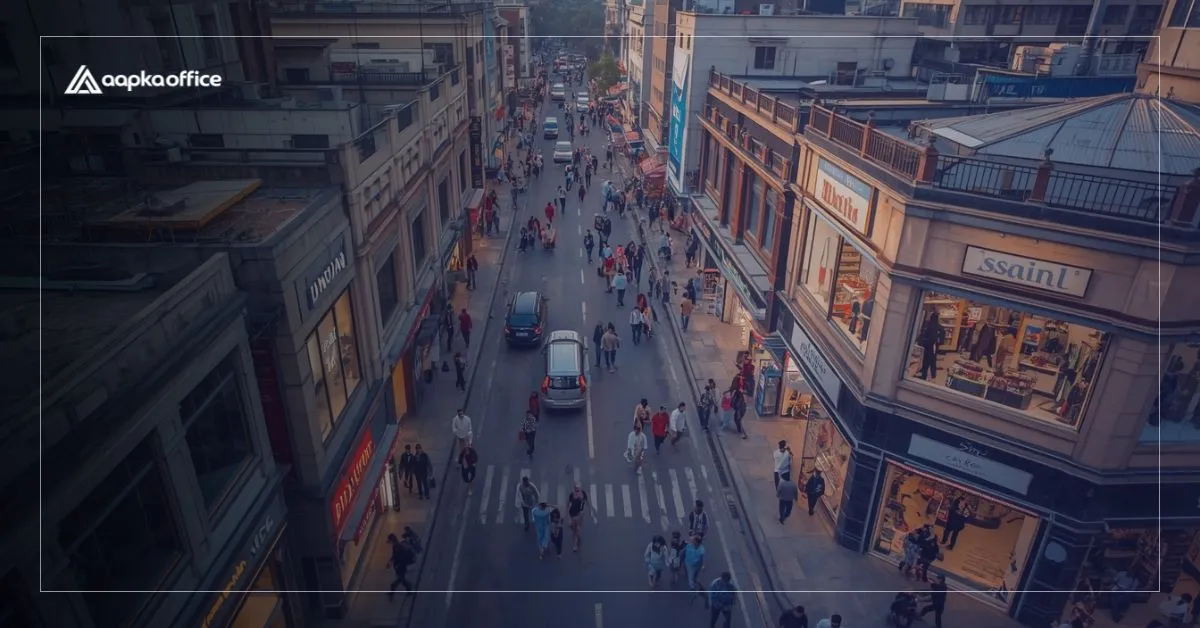
Delhi NCR’s retail real estate market in 2025 to 2026 is bifurcating along a line that most retail brands have not yet mapped precisely.
On one side of the line: high streets and retail strips where rents are rising 15 to 30% annually — driven by post-COVID consumer spending recovery, improving metro connectivity, rising catchment income, and the constrained supply of quality retail frontage in high-demand locations. Brands that secured these locations 12 to 18 months ago are now sitting on leases significantly below current market.
On the other side: secondary high streets, mall corridors, and peripheral commercial strips where rents have been flat or declining since 2020 — where landlords are still offering the concessions that characterised the COVID trough, and where the brands that signed recently have the best terms in a decade.
The decision that matters for retail brands right now is identifying which side of this line their target locations fall on — and acting accordingly. For locations in the appreciating segment, the window to sign at current rents is narrowing as landlords respond to rising demand by firming up asking rents and withdrawing concessions. For locations in the flat segment, time is on the tenant’s side.
This guide identifies the specific NCR high streets and retail corridors where rents are rising fastest, explains the specific driver behind each market’s appreciation, and maps the brand profiles that need to move before the current window closes.
1. The Drivers of Retail Rent Appreciation in Delhi NCR
Retail rent appreciation in NCR in 2025 to 2026 is being driven by a combination of demand-side and supply-side factors that are operating differently across micro-markets. Understanding which driver is active in each market determines whether the appreciation is durable or cyclical.
Driver 1 — Metro connectivity improvement:
New metro station openings and the maturation of recently opened stations are the single most consistent driver of retail rent appreciation in NCR. As analysed in the metro expansion opportunities blog, metro access drives footfall, which drives retail viability, which drives landlord rent expectations. Markets that received new metro stations in 2020 to 2023 are now in Phase 3 of the commercial property response cycle — ecosystem development with accelerating rent appreciation.
Driver 2 — Post-COVID consumer spending recovery:
India’s urban consumer spending on discretionary categories — eating out, fashion, personal care, electronics, and experiential services — has recovered past pre-COVID levels and is growing on top of the recovery base. This demand recovery has been strongest in the premium and mid-premium segments: the brands and categories that serve SEC A and B consumers in their spending prime. High streets that serve these demographics are capturing the spending recovery disproportionately.
Driver 3 — Constrained quality retail supply:
In the premium NCR high streets — Khan Market, Saket G Block, GK I M Block — there is essentially no new supply. The buildings are old and fixed in number. Tenants who want to be in these markets must compete for a static supply. This supply constraint amplifies the demand effect and produces outsized rent appreciation.
Driver 4 — Brand flight to quality:
Post-COVID, the performance gap between high-footfall premium high streets and secondary retail has widened. Brands that rationalised their store networks during COVID have been reopening selectively — prioritising the high-performing locations and avoiding the marginal ones. This selective reopening has disproportionately increased demand for top-performing high streets while the secondary markets remain weak.
2. The Fastest-Rising Markets — Location by Location
Market 1 — Khan Market, New Delhi
Current rent range: ₹600 to ₹1,000 per sq ft per month (ground floor prime frontage)
Year-on-year appreciation: 18 to 25%
Why it is rising:
Khan Market has been India’s most expensive high street by rent per sq ft for more than a decade. Its resilience through COVID was notable — premium brands maintained their presence through concessions and deferrals rather than exiting. The recovery has been sharp: footfall from the Lutyens Delhi residential and diplomatic catchment rebounded strongly in 2022 to 2023, and the consumer profile — with among the highest per-capita discretionary spending in India — has continued to strengthen.
The specific driver of the current appreciation cycle: a wave of international premium brands entering the Indian market for the first time, targeting Khan Market as their first India store precisely because of its visibility and its catchment’s openness to international brands.
The supply constraint:
Khan Market’s built environment is fixed — the colonial-era buildings cannot be expanded vertically or horizontally. When a single unit becomes available, multiple competing brands are typically notified within days. Competition for availability is the primary mechanism driving rent appreciation.
Which brands should move now:
Premium international brands entering India who need a flagship store in a market that signals brand quality to their target demographic. Luxury food and beverage concepts. Premium personal care and wellness brands. High-end home decor and lifestyle brands.
The window: Rents are unlikely to decline and supply will not increase. Brands that want a Khan Market presence should move as soon as a suitable space becomes available — waiting for a better market moment is waiting for something that will not come.
Market 2 — Saket G Block / Select City Walk Adjacent
Current rent range: ₹350 to ₹600 per sq ft per month (prime frontage)
Year-on-year appreciation: 15 to 22%
Why it is rising:
Saket G Block is South Delhi’s most active premium F&B and lifestyle high street. The combination of proximity to Select City Walk mall (providing anchor footfall), the Saket metro station (Yellow and Pink Line interchange — one of NCR’s busiest interchange stations), and the residential catchment from Saket, Malviya Nagar, and Greater Kailash has produced one of NCR’s strongest retail footfall environments.
The specific appreciation driver: the Pink Line’s completion opened up a new residential catchment from East Delhi and North East Delhi that previously did not access Saket easily. The Saket metro station is now an interchange between two lines — daily ridership has increased substantially since the Pink Line was extended.
The supply reality:
G Block’s street frontage is largely occupied. Availability appears only when leases expire or brands exit — which happens less frequently as lease terms have been signed more recently and brands are performing well. The typical waiting period between a space becoming available and being leased is now 4 to 8 weeks in G Block — significantly shorter than 12 to 18 months ago.
Which brands should move now:
Premium F&B brands (restaurants, cafés, speciality food). Boutique apparel and accessories brands. Beauty and personal care in the premium segment. Fitness and wellness studios.
The window: The lease opportunity in G Block at current rents is available only when businesses exit. Brands that want to be here should instruct their brokers to monitor G Block specifically and move quickly when availability appears — the window between space becoming available and being leased is 4 to 8 weeks.
Market 3 — GK I M Block Market, South Delhi
Current rent range: ₹380 to ₹650 per sq ft per month
Year-on-year appreciation: 12 to 18%
Why it is rising:
GK I M Block has historically been one of South Delhi’s premier destination retail streets — a mix of premium fashion boutiques, F&B, and lifestyle brands in a pedestrian-friendly environment. Its recovery from COVID has been strong, driven by the SEC A residential catchment’s spending recovery and the capture of footfall from the adjacent residential density.
The specific driver of current appreciation: A wave of successful F&B openings in 2022 to 2024 that converted GK I from a primarily fashion-destination street to a food and lifestyle destination — bringing in consumer profiles from beyond the immediate catchment and increasing the footfall value for all tenants on the street.
Which brands should move now:
Established boutique fashion brands looking for their South Delhi flagship. Premium dining and experiential F&B concepts. Personal care and wellness.
The window: The appreciation cycle in GK I has been running for 2 to 3 years. Rents that were ₹280 to ₹320 per sq ft in 2020 to 2021 are now ₹380 to ₹650 per sq ft. There is still availability — but at each passing quarter the floor rises. Brands that have been evaluating should move before the next rent step-up.
Market 4 — South Extension Part 1 and Part 2
Current rent range: ₹320 to ₹520 per sq ft per month (Part 1 prime); ₹260 to ₹420 per sq ft (Part 2)
Year-on-year appreciation: 10 to 15%
Why it is rising:
South Extension is one of Delhi’s oldest and most established retail destinations — a large-format market serving the South Delhi consumer population. Post-COVID, South Extension has benefited from the overall South Delhi spending recovery and from the entry of organised brand operators (national fashion chains, QSR brands, beauty retailers) who are strengthening the tenant mix and increasing destination footfall.
The South Extension metro station (Pink Line) provides good north-east Delhi connectivity — bringing a new catchment that was previously accessing South Extension only by road.
Which brands should move now:
National fashion and apparel chains seeking large-format South Delhi flagship stores. QSR brands with proven footfall models. Beauty and personal care category operators.
The window: South Extension is a large market with more availability than GK I or Saket G Block. The appreciation rate is meaningful but the window is longer — 12 to 24 months before rents reach levels that make entry structurally difficult for mid-premium brands.
Market 5 — Cyber Hub / DLF Cyber City Area, Gurugram
Current rent range: ₹450 to ₹900 per sq ft per month (prime units)
Year-on-year appreciation: 20 to 30%
Why it is rising:
Cyber Hub — the mixed-use development adjacent to DLF Cyber City — has established itself as Gurugram’s premier F&B and lifestyle destination over the last 5 years. The captive audience of 80,000+ daily office workers in the Cyber City complex, combined with the destination dining appeal that has made Cyber Hub a weekend and evening destination for Gurugram’s residential population, produces one of NCR’s highest-density retail footfall environments.
The specific driver of current appreciation: The return-to-office movement post-COVID has fully restored the weekday lunch and post-work footfall that was the market’s core revenue driver. The development has added capacity incrementally — but demand has grown faster than supply, producing a tight availability environment.
The waitlist reality:
Several of the best Cyber Hub units operate with a waiting list of brands seeking entry. When a unit becomes available, it is typically leased to a brand already known to the development management within 2 to 4 weeks. Cold approaches from brands unknown to the management team are rarely successful.
Which brands should move now:
Premium F&B with proven multi-city track records. International brands entering the Indian F&B market. Fitness and wellness concepts. Corporate-casual dining formats that serve the office catchment efficiently.
The window: Cyber Hub premium units are at near-peak pricing. The window for entry at reasonable rents has largely closed — the question for brands is whether the footfall quality justifies the premium, not whether there is a below-market entry opportunity.
Market 6 — Sector 29 Gurugram (Leisure Valley / Food Strip)
Current rent range: ₹200 to ₹380 per sq ft per month
Year-on-year appreciation: 18 to 25%
Why it is rising:
Sector 29 in Gurugram — the leisure strip near Leisure Valley Park — emerged post-COVID as one of NCR’s most active dining and entertainment destinations for the young professional demographic. The combination of outdoor format establishments, affordable premium pricing, and strong weekend footfall from Gurugram’s large young professional population has produced a retail micro-market that is growing faster than most comparable strips in NCR.
The supply and opportunity:
Sector 29 still has ground-floor and basement availability at rents significantly below comparable South Delhi markets. The catchment quality is high — Gurugram’s young professional and GCC workforce demographic. The appreciation has been strong but the absolute rent level (₹200 to ₹380 per sq ft) remains accessible to mid-market brands.
Which brands should move now:
Young professional-oriented F&B brands. Casual dining. Fitness and lifestyle brands targeting the 25 to 40 demographic. Entertainment and experiential retail.
The window: The most genuine near-term entry opportunity on this list. Sector 29 rents are rising fast but remain 40 to 60% below comparable South Delhi markets. The 12 to 18 month window before rents reach levels that make mid-market entry difficult is open now.
Market 7 — Connaught Place Inner Circle (Selective Appreciation)
Current rent range: ₹500 to ₹850 per sq ft per month (Inner Circle prime)
Year-on-year appreciation: 10 to 15% in select categories (F&B and experiential); flat in legacy retail
Why it is selectively rising:
Connaught Place as a whole is a market of two halves. Legacy retail — the pharmacy, the stationery shop, the government bank branch — has been under pressure from e-commerce competition and declining footfall from younger consumers. F&B and experiential concepts — restaurants, bars, cafés, and entertainment destinations that benefit from the Rajiv Chowk metro’s daily 300,000+ ridership — are appreciating strongly.
The specific driver: The position of Rajiv Chowk as NCR’s most-connected metro interchange (Yellow, Blue, and Green Lines meeting here) has made Connaught Place the transit hub for the entire north-south and east-west metro network. The commuter footfall at peak hours is among the highest in any commercial district in India — creating exceptional visibility and impulse purchase opportunity for brands positioned near the station exits.
Which brands should move now:
QSR and quick-service F&B with high-throughput models. Pharmacy and health convenience. Mobile and electronics accessories. Experiential concepts that benefit from high transit footfall.
The window: F&B units in the Inner Circle with prime station access are genuinely difficult to secure — the category’s appreciation has been ongoing for 3 years and the availability is limited. Brands targeting this market should act now rather than wait.
Market 8 — Rajouri Garden Main Market, West Delhi
Current rent range: ₹280 to ₹450 per sq ft per month
Year-on-year appreciation: 15 to 20%
Why it is rising:
Rajouri Garden has historically been West Delhi’s premier fashion and retail destination — a large, well-established market serving the dense middle and upper-middle income residential catchment of West Delhi. The market has benefited from the metro (Rajouri Garden station on Blue Line) and has been steadily strengthening its tenant mix with organised national brands.
The specific driver: The continued strengthening of West Delhi’s consumer economy — the residential population’s income growth, the reduction in consumer leakage to South Delhi and Gurugram as West Delhi’s own retail environment improves, and the metro connectivity that has made Rajouri Garden accessible from the Blue Line network.
Which brands should move now:
National fashion chains seeking West Delhi coverage. Mid-premium F&B operators. Beauty and personal care national operators.
The window: Rajouri Garden remains accessible for mid-premium brands at ₹280 to ₹380 per sq ft. The appreciation rate means this access window will narrow materially over the next 12 to 18 months. Brands evaluating West Delhi entry should act in the current window.
Market 9 — Sector 18 Noida (Selective Premium Units)
Current rent range: ₹200 to ₹380 per sq ft per month
Year-on-year appreciation: 12 to 18% in best units; flat in secondary units
Why prime units are rising:
Sector 18 is Noida’s most established retail and commercial destination, well-served by the Blue Line metro. The post-COVID recovery in Noida has been driven by GCC and technology employment growth — producing a more affluent consumer base than the pre-COVID Sector 18 catchment. This consumer upgrade is reflected in the premium unit appreciation.
The bifurcation:
The appreciation is concentrated in the best-located, best-fronted ground-floor units on the primary commercial streets. Secondary units in Sector 18’s smaller side streets have not appreciated — they remain in the flat segment of the market. The key skill in Sector 18 is identifying which specific units are in the appreciating set.
Which brands should move now:
Premium F&B brands seeking Noida’s first major footprint. National fashion operators seeking Noida entry. Brands whose consumer profile matches the growing GCC/technology professional demographic.
3. The Markets to Approach Differently — Flat or Declining, High Leverage Available
Not every NCR retail market is appreciating. Several significant markets remain in a flat or declining phase where tenant leverage is high and entry terms are favourable.
Markets with strong tenant leverage in 2025 to 2026:
Karol Bagh Main Market: Struggling with competition from e-commerce in its core categories (electronics, fashion accessories). Vacancy is elevated in upper floors. Ground-floor prime units are holding rents, but upper floors offer significant negotiating leverage. Brands that can use upper floors (fitness studios, services) have exceptional cost opportunity.
Nehru Place: IT and electronics retail is under sustained pressure from e-commerce. Significant vacancy in the Grade B buildings. Brands targeting the professional B2B market or providing category-relevant services (tech support, software, IT consulting) can secure space at below-market rents with strong concessions.
Lajpat Nagar Central Market: Fashion retail is competitive but the market has meaningful secondary unit availability. A brand that can differentiate in the fashion category and take secondary units can secure strong 3-year terms before the market tightens.
Noida Expressway retail (Sectors 125-135): Significant retail vacancy in the mixed-use Expressway developments. For brands whose consumer base is in the Expressway residential belt, exceptional entry terms are available — long rent-free periods, fit-out contributions, and below-peak rents that are unlikely to get materially cheaper.
4. The Timing Decision — How to Read a Specific Market’s Appreciation Stage
For any specific retail market being evaluated, the appreciation stage determines the urgency of the leasing decision.
Stage 1 — Pre-appreciation (act within 12 months):
Indicators: New metro station opened or completing within 6 months; vacancy above 15% in a market with strong residential catchment; asking rents still below market equilibrium; no brand queues for available units.
Current NCR examples: Selected emerging metro corridor strips discussed in the metro expansion blog; parts of Faridabad’s improving commercial belt.
Stage 2 — Early appreciation (act within 6 months):
Indicators: Vacancy declining from elevated levels; 3 to 4 new F&B or lifestyle brands opened in the last 6 months signalling market confidence; asking rents rising but still 15 to 20% below the expected equilibrium; some competing demand for good units but not multiple simultaneous bids.
Current NCR examples: Sector 29 Gurugram, Sector 18 Noida prime units, Rajouri Garden Main Market.
Stage 3 — Established appreciation (act as soon as unit is available):
Indicators: Vacancy below 10%; branded tenants actively competing for available units; asking rents at or above market equilibrium with minimal negotiating room; time from availability to leasing is 4 to 8 weeks.
Current NCR examples: Khan Market, Saket G Block, GK I M Block, Cyber Hub prime units.
Stage 4 — Peak (evaluate carefully):
Indicators: Rents have appreciated 30 to 50%+ from trough; market is fully leased; new competition entering in adjacent locations; consumer footfall growth is moderate rather than exceptional.
Current NCR examples: Certain Cyber Hub premium units; Khan Market prime ground floor.
5. The Category-Specific Analysis — Which Brands Need to Move Where
Not every brand type benefits equally from every appreciating market. The category analysis determines which specific location is the urgent opportunity for which brand profile.
Premium F&B (Full Service Restaurants, Premium Cafés, Bar and Dining Concepts)
Urgent locations: Khan Market (diminishing availability — act on every opportunity), Saket G Block (2 to 4 week availability windows), Sector 29 Gurugram (12 to 18 month window before pricing becomes restrictive), GK I M Block.
Current window characteristics: Sector 29 offers the most accessible premium F&B entry in NCR’s strongest-appreciating markets. The rents at ₹200 to ₹380 per sq ft allow premium F&B economics to work with standard ticket pricing. At ₹450 to ₹700 per sq ft (the likely trajectory in 24 months), the same F&B model requires either a higher ticket price or a higher table turn rate to remain viable.
National Fashion Chains (Mid-Premium to Premium Apparel)
Urgent locations: South Extension Part 1 (largest format availability in a South Delhi premium market), Rajouri Garden Main Market (West Delhi coverage with 12 to 18 month window), Sector 18 Noida prime units.
The timing argument: Fashion retail requires substantial fit-out investment — ₹2,000 to ₹4,000 per sq ft for a national brand’s standard store format. The ROI on this investment is undermined by escalating rents that reduce the store’s profitability over its payback period. Signing at current rents — before the next appreciation step-up — significantly improves the 3 to 5 year store economics.
Fitness and Wellness Studios
Urgent locations: GK I M Block (premium South Delhi positioning), Connaught Place (transit footfall for express formats), Sector 29 Gurugram (young professional demographic match), Rajouri Garden (large format availability at accessible rents).
The category-specific timing argument: Fitness and wellness studios are space-intensive (minimum 2,000 to 5,000 sq ft for a functional studio) and have high fit-out costs (₹2,500 to ₹5,000 per sq ft for specialist flooring, equipment installations, HVAC upgrades). The combination of space-intensive requirements and high fit-out cost makes rent appreciation particularly damaging — a 25% rent increase on a 3,500 sq ft studio is ₹2.5 to ₹5 lakh per month depending on the base rent. Signing now in an appreciating market locks in current rents for the full lease term.
Quick Service Restaurants and Food Delivery Dark Kitchens
Urgent locations: Connaught Place metro-adjacent units (transit footfall is QSR gold), Rajiv Chowk exit points (highest transit density in NCR), metro station ground floor commercial anywhere on the Yellow Line.
The category-specific argument: QSR and delivery kitchen economics are highly sensitive to rent per sq ft because the space utilisation is dense (30 to 80 sq ft per cover for QSR; 500 to 1,500 sq ft for a dark kitchen) and the ticket size is moderate. High-footfall transit locations are genuinely more viable than high-rent destination locations for QSR formats — but transit-adjacent rents are appreciating as operators discover this.
Beauty and Personal Care (Salon, Spa, Skincare Retail)
Urgent locations: Saket G Block, GK I M Block, Sector 29 Gurugram, Rajouri Garden.
The timing argument: Premium beauty is the fastest-growing physical retail category in India’s urban market. The competition for the best locations in South Delhi and Gurugram from both domestic and international beauty brands is intensifying. The brands that have been in evaluation mode for 6 to 12 months will find their preferred locations leased to competitors if they do not move in the current window.
6. The Negotiation Position — What Is Still Achievable in Rising Markets
Moving quickly does not mean accepting any terms. Even in appreciating markets, specific lease terms are negotiable — and securing the right terms on a rising-market lease is as important as securing the space.
Escalation rate:
In an appreciating market, landlords will push for 15% every 3 years — and in the tightest markets (Khan Market, Cyber Hub) they will succeed. In markets that are appreciating but not yet peak (Sector 29, Rajouri Garden), push for 10% every 3 years. The difference over a 5-year lease on a ₹3 lakh per month rent: ₹7.2 lakh cumulatively. Worth arguing for.
Fit-out period:
Even in an appreciating market, the fit-out period (rent-free while constructing the store) should be 8 to 12 weeks for a full store fit-out. Landlords in strong markets will offer 4 to 6 weeks. Push for 10 to 12 weeks — it is commercially reasonable and most landlords will accept it for a creditworthy brand.
Restoration clause:
Negotiate the restoration obligation specifically — what must be removed at the end of the lease. For a brand with a high-quality custom fit-out, a clause that allows the landlord to retain the fit-out in lieu of restoration is valuable — it avoids the ₹15 to ₹30 lakh cost of restoration on exit.
Lock-in period:
In a rising market, accept a 2 to 3 year lock-in — it is the price of securing the space. But negotiate the period after lock-in carefully: a 3-year lock-in on a 5-year lease with a 90-day notice period after the lock-in is a standard commercial arrangement that is achievable in most NCR retail markets.
What the Rising Markets Are Telling the Retail Sector
The divergence between NCR’s rapidly appreciating retail locations and its flat or declining ones is not arbitrary. It reflects the structural shift in India’s physical retail market — away from the model where almost any high-street location could sustain almost any retail format, toward a model where the best locations are concentrating the best footfall and the best consumer profiles, and the secondary locations are discovering that the e-commerce alternative has permanently redistributed demand away from them.
For retail brands, the implication is clear. A store in Khan Market, Saket G Block, or Sector 29 Gurugram is not equivalent to a store in a secondary high street with similar rent — the footfall quality, the consumer spending power, and the brand visibility of these locations are genuinely superior in ways that justify their higher rents.
The brands that are moving now in the appreciating markets are not paying more for equivalent retail exposure. They are paying more for materially better retail exposure — and they are locking in that superior exposure at rents that will look reasonable when the appreciation cycle has run another 18 to 24 months.
The brands that are waiting for the market to soften are waiting for something that the supply constraints, the metro expansion, and the consumer spending recovery dynamics suggest will not come in the markets that matter most.