
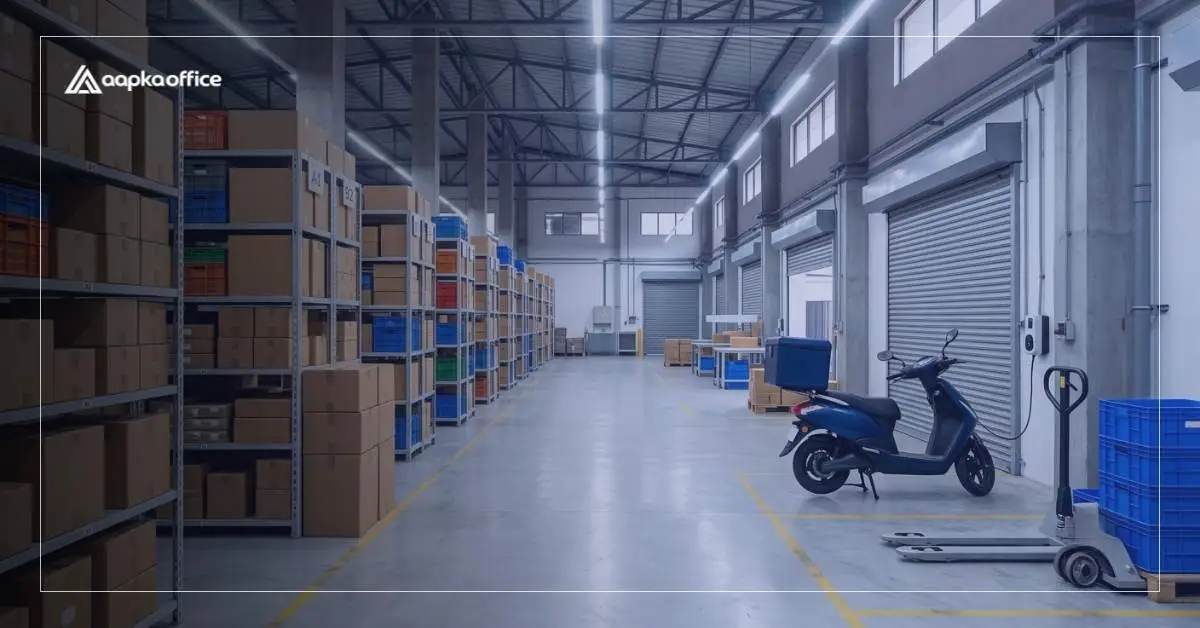
Quick-commerce leasing rose from an average 0.35 million sq ft/year (2020-23) to over 1.2 million sq ft in a single year by 2024, per CBRE’s India Industrial & Logistics Outlook. This piece lays out market size, the competitive landscape driving demand, geographic concentration, and the parallel growth in conventional warehousing.
The market size behind the real estate demand
India’s Q-commerce market is valued at ~$3.65 billion in 2026, projected to reach $6.64 billion by 2031 at a 12.74% CAGR (Mordor Intelligence). A separate projection puts growth from $5.48 billion (2024) to ~$12.97 billion by 2029. Both point to sustained, multi-year growth underpinning real estate demand.
The competitive landscape driving where dark stores get leased
As of January 2026, India operated ~6,280 dark stores, up from ~5,990 a month earlier. A March 2026 count across the three largest platforms found 4,081 operational stores.
| Platform | Dark Store Count | Share of GOV |
|---|---|---|
| Blinkit (Eternal) | 1,954 | ~46% |
| Zepto | 1,089 | ~22% |
| Swiggy Instamart | 1,038 (network >1,100) | ~24% |
| Amazon Now / Flipkart Minutes | 500+ each | — |
| BigBasket (BB Now) | — | 5–7% |
These six players lease space in overlapping urban catchments, driving the leasing surge above. Swiggy Instamart added a record 316 dark stores in one quarter (Q4 FY25) while GOV grew 101% YoY to ₹4,670 crore — even as its adjusted EBITDA loss widened to ₹840 crore, showing physical expansion continuing despite unit-economics pressure.
Where dark stores are concentrated geographically
The 4,081 tracked stores span 408 cities in 26 states, led by Maharashtra, Karnataka, and Uttar Pradesh. Blinkit’s network is the most geographically dispersed, reaching smaller cities competitors haven’t entered — a real demand source for landlords in tier-2/3 markets specifically.
What changed: dark stores became a real estate category, not a side effect
Dark store demand reached 24 million sq ft by 2023, projected to grow at a 12% CAGR (JLL/Miebach Consulting). Unlike traditional warehousing, dark stores prioritize proximity to residential density over highway access — small-format spaces of 2,000-4,000 SKUs embedded in urban neighborhoods.
What financial impact this has
JLL estimates the dark-store model can cut logistics costs 10-30% versus conventional last-mile delivery. That’s a unit-economics-led driver, not a marketing-led one — relevant given several major platforms still operate at significant EBITDA loss while expanding aggressively.
The parallel story: broader industrial and logistics leasing is also accelerating
Cushman & Wakefield reported India’s logistics and industrial leasing hit a record 36.2 million sq ft in H1 2026, up 18% YoY — driven by e-commerce, 3PL, and FMCG occupiers alongside quick-commerce’s parallel urban network.
Where conventional demand concentrates: established logistics corridors
Bhiwandi (Mumbai outskirts) captures an estimated 80-85% of regional leasing, positioned at NH 48, a direct NH 160 link to JNPT, and near Mumbai’s international airport. Rents range ₹10-24/sq ft, with recent large transactions at the higher end. An eight-lane highway upgrade (Thane-Bhiwandi-Padgha-Kalyan-Nashik, targeted for 2026 completion) should open new institutional-grade zones. Farrukhnagar (Delhi-NCR) is a comparable corridor.
What operational impact this has on site selection
Dark-store site selection should be treated as genuinely distinct from conventional warehousing — residential density and delivery-radius efficiency matter more than highway proximity. Given how fragmented the competitive landscape remains, landlords with vacant urban ground-floor space have a real, still-expanding tenant category to consider.
What to do next
Map current and planned dark-store demand against your portfolio rather than assuming one warehousing strategy fits all. Given the pace of store additions (300 net new nationally in a single month, January 2026), treat demand data as needing quarterly, not annual, review.
FAQ
How big is India’s quick-commerce market?
~$3.65 billion in 2026, reaching $6.64 billion by 2031 at 12.74% CAGR (Mordor Intelligence); a separate estimate projects $12.97 billion by 2029.
How many dark stores operate in India?
~6,280 as of January 2026; 4,081 across the three largest platforms alone as of March 2026, spanning 408 cities in 26 states.
Which player has the largest footprint?
Blinkit — 1,954 stores (~48% of the three-platform total) and ~46% GOV share, the most geographically dispersed network.
How fast is dark-store demand growing?
24 million sq ft by 2023, projected at a 12% CAGR (JLL/Miebach).
How is broader logistics leasing performing?
A record 36.2 million sq ft in H1 2026, up 18% YoY (Cushman & Wakefield).
Sources: CBRE India; JLL/Miebach Consulting; Knight Frank India; Cushman & Wakefield; Mordor Intelligence; Datum Intelligence (via Reuters); quickcommercemap.com.