
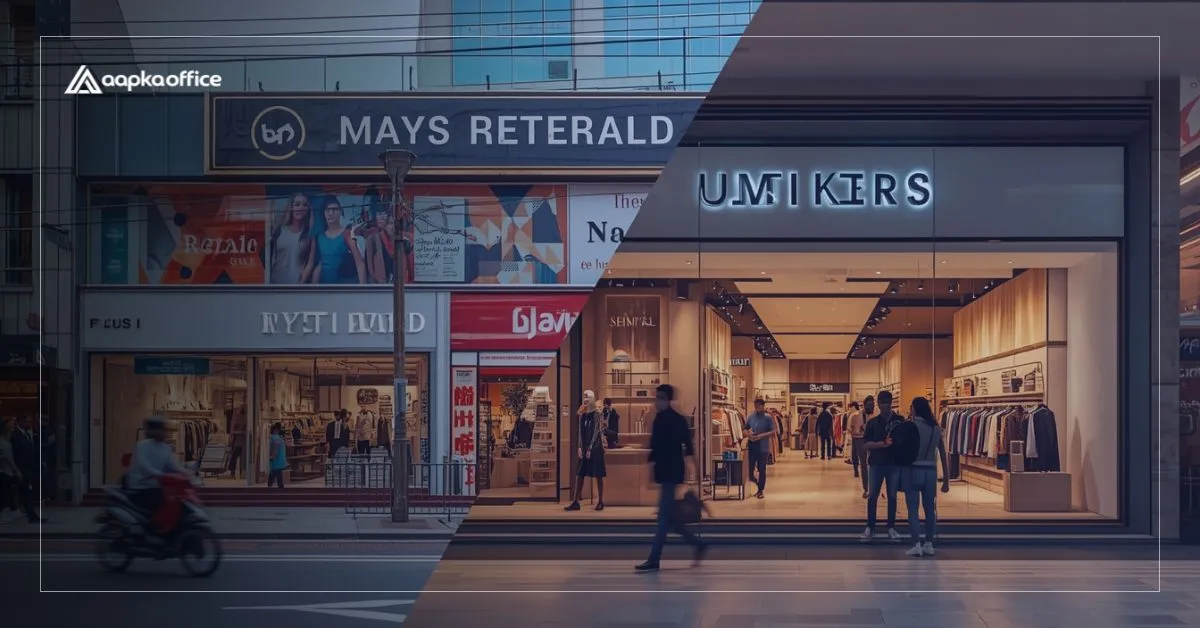
A brand that chooses the wrong retail format does not usually know it immediately.
The first month looks fine. The second month looks acceptable. By month six, the pattern is clear — footfall that was promised has not materialised, the customer profile walking past the shop is not the customer the brand is selling to, or the economics of the lease are eating margins that were supposed to fund growth.
The choice between a high-street shop and a mall unit is one of the most consequential decisions any retail brand makes — and it is made with insufficient analysis far more often than it should be.
Most brands make this choice based on instinct, aspiration, or cost — without rigorously evaluating the specific commercial logic that makes one format work and the other fail for their specific product, customer, and stage of growth.
A premium jewellery brand in a mid-market mall will underperform regardless of the product quality. A fashion brand relying on impulse purchase in a standalone high-street shop with no anchor footfall will struggle regardless of the merchandising. The format and the product must be aligned — or the location will not save the brand.
This article gives Indian brands and the brokers who serve them a complete, honest picture of what high-street and mall retail actually deliver — on footfall, cost, lease terms, operational flexibility, and strategic fit — so the choice is made on evidence rather than preference.
1. Understanding the Fundamental Difference — What Each Format Is Built For
Before comparing costs or lease terms, it helps to understand the structural logic of each format — because each is built around a different customer behaviour and a different commercial model.
High-street retail is built around destination and passthrough traffic. Customers are on the street for a variety of reasons — commuting, errands, dining, general activity — and the shop captures the attention of the passerby or draws the deliberate visitor who came specifically to the street. The high street works for brands that are strong enough to draw their own traffic or that benefit from the organic flow of a busy commercial corridor.
Mall retail is built around engineered footfall. The mall developer creates a controlled environment — anchored by large-format tenants, F&B, entertainment, and events — specifically designed to bring people in and keep them circulating past retail units. The individual brand in a mall is buying access to that engineered footfall — the developer’s investment in creating the environment that makes people browse and buy.
The commercial consequence of this difference:
A brand that can draw its own traffic — that has strong brand equity, a specific destination category, or a loyal repeat-purchase customer — does not need to pay the mall premium to access engineered footfall. It can operate more cost-effectively on a high street, where it controls its own environment and pays less for the location.
A brand that relies on impulse purchase, discovery, or browsing-led conversion — where customers need to encounter the product before they know they want it — benefits significantly from the consistent footfall that a well-anchored mall delivers. The mall’s premium is justified because without it, the discovery traffic does not exist.
This is the core question every brand must answer before choosing a format: does the brand draw traffic, or does it need footfall delivered to it?
2. Footfall — Quantity, Quality, and the Difference Between the Two
Footfall is the metric that seems most straightforward — and is the most frequently misunderstood.
Total footfall is not the relevant metric. The relevant metric is qualified footfall — the number of people passing or entering who match the brand’s customer profile and are in a mindset to purchase.
High-street footfall:
High-street footfall in India’s major commercial retail corridors is often higher in absolute number than mall footfall — a busy high street in Connaught Place, Lajpat Nagar, or Linking Road Mumbai sees tens of thousands of people per day. But the footfall is heterogeneous — commuters, through-traffic, errand-runners, and shoppers are all mixed together.
Conversion from high-street footfall is lower than from mall footfall — because a significant proportion of the people passing a high-street shop are not in a shopping mindset. They are going somewhere else. The brand’s job is to interrupt that journey and create an impulse that was not already there.
This is harder — and requires stronger visual merchandising, frontage design, and stopping power than a mall unit requires.
Mall footfall:
Mall footfall is lower in absolute number but higher in shopping intent. People who go to a mall go there to shop — or to eat, which often leads to shopping. They have already made a decision to be in a retail environment. The conversion from visitor to browser, and from browser to buyer, is structurally higher in a mall than on a high street.
But mall footfall is not equally distributed across the mall. Ground floor, main atrium-facing units, units near anchor tenants, and units near food courts see meaningfully more footfall than units on upper floors, in peripheral corridors, or far from the main circulation paths.
The location within the mall matters as much as the mall itself. A poor location in a premium mall can underperform a good location in a secondary mall. A brand that signs a mall lease without understanding its specific unit’s position in the mall’s footfall flow is making a critical mistake.
Questions about footfall that must be answered before committing:
For a high street:
- What is the footfall count on this specific stretch — not the broader market? Have you counted it yourself during peak and off-peak hours, on weekdays and weekends?
- What proportion of the footfall matches the brand’s customer profile?
- Is this footfall growing or declining — has a nearby anchor closed, or is new development bringing more people to this street?
For a mall:
- What is the mall’s total monthly footfall — confirmed from the mall management’s data, not claimed?
- Where is the specific unit positioned relative to the main anchor tenants, the food court, and the primary entrance?
- What is the footfall on this specific floor and corridor — not the mall average?
3. The Cost Structure — High Street vs Mall, Honestly Compared
The cost of retail space in India differs not just in the base rent but in the structure of the financial commitment — and understanding the difference prevents significant budget surprises after signing.
High-street retail — the cost structure:
A high-street retail lease is typically a straightforward rent-based structure — similar to a commercial office lease but simpler in most cases. The tenant pays:
- Base rent — per sq ft per month, negotiated directly with the property owner
- Security deposit — typically 3 to 6 months’ rent in most Indian retail markets
- Maintenance charges — in a standalone or small complex, often nominal or included in rent
- Utilities — electricity and water billed separately
- Fit-out cost — the tenant’s own investment to create the shop environment
High-street retail costs are more transparent — what is quoted is closer to what is paid, with fewer additional charges than a mall lease involves.
High-street rent benchmarks in key markets (approximate, 2025–26):
| Market | High street | Approximate rent range |
| Delhi — Connaught Place | Central Business District | ₹300–₹600 per sq ft per month |
| Delhi — Khan Market | Premium specialty retail | ₹500–₹900 per sq ft per month |
| Delhi — Lajpat Nagar | Mass fashion and ethnic | ₹150–₹300 per sq ft per month |
| Gurugram — MG Road | Mixed retail corridor | ₹200–₹400 per sq ft per month |
| Noida — Sector 18 | Mid-market retail | ₹150–₹280 per sq ft per month |
| South Delhi — Defence Colony | Specialty and F&B | ₹250–₹450 per sq ft per month |
Mall retail — the cost structure:
Mall retail is fundamentally more complex. The tenant does not just pay rent. They pay rent plus a share of the mall’s operating costs plus potentially a revenue share with the mall — and the combination of these can make the stated base rent a misleading guide to actual occupancy cost.
The components of a mall retail lease:
Minimum Guaranteed Rent (MGR): The fixed monthly rent the tenant pays regardless of sales performance. This is the floor — the minimum the mall receives even if the brand has a terrible month.
Revenue share (turnover rent): Most Indian mall leases include a provision where the tenant pays the higher of the MGR or a percentage of their monthly gross revenue. Typical revenue share percentages by category:
| Category | Typical revenue share % |
| Fashion and apparel | 8–12% |
| Footwear | 8–10% |
| Food and beverage — QSR | 10–14% |
| Fine dining | 6–9% |
| Electronics | 4–6% |
| Jewellery and watches | 5–8% |
| Beauty and personal care | 10–14% |
| *Hypermarket / anchor | 1–3% |
The revenue share model means that successful brands pay more as they perform better — which is the mall’s mechanism for capturing a share of the value their footfall infrastructure delivers. For a brand with strong margins, this is acceptable. For a brand with thin margins, it can be punishing.
Common Area Maintenance (CAM): Mall CAM charges are typically higher and more complex than commercial office CAM — covering the mall’s cleaning, security, energy, events management, and the cost of maintaining the atrium, food court, and common areas that generate the footfall.
Mall CAM in Indian Grade A malls runs approximately ₹50 to ₹150 per sq ft per month — significantly higher than commercial office CAM.
Marketing fund contribution: Most Indian malls charge tenants a monthly contribution to the mall’s marketing fund — used to fund advertising, events, seasonal campaigns, and the marketing activities that drive mall traffic. This is typically ₹10 to ₹30 per sq ft per month and is non-negotiable in most cases.
The all-in cost comparison (for a 1,000 sq ft unit):
| Component | High-street (illustrative) | Mall (illustrative) |
| Base rent | ₹2,50,000 per month | ₹1,80,000 per month (MGR lower) |
| CAM charges | ₹15,000 | ₹80,000 |
| Marketing fund | None | ₹15,000 |
| *Revenue share (if turnover exceeds MGR threshold) | None | Variable — can be significant |
| GST at 18% | ₹47,700 | ₹49,500 |
| Total before revenue share | ₹3,12,700 | ₹3,24,500 |
At the base level, the all-in costs are comparable. The difference emerges when the brand performs well — the mall captures an additional percentage of revenue that the high street does not.
For a fashion brand generating ₹20 lakh per month in revenue from a 1,000 sq ft unit, a 10% revenue share produces ₹2 lakh per month in turnover rent — significantly above the MGR. The effective total occupancy cost approaches ₹5.5 lakh per month — 70% higher than the stated base rent.
4. Lease Terms — How Mall and High-Street Leases Differ Structurally
The structural differences in lease terms between high-street and mall retail are as significant as the cost differences — and understanding them before signing prevents commitments that cannot be undone.
High-street lease characteristics:
- Direct landlord-tenant relationship — the negotiation is between the brand and the property owner, often an individual or a family
- More flexible on lock-in — particularly for standalone buildings or smaller complexes where the landlord values a quality tenant over strict terms
- Simpler document — a leave and licence agreement or a commercial lease deed without the complexity of mall-specific provisions
- Greater scope for negotiation — on rent, deposit, fit-out period, lock-in, and escalation
- Less standardised — terms vary widely between different high-street properties and owners
Mall lease characteristics:
- Non-negotiable standard clauses — most Grade A mall developers (DLF, Phoenix, Nexus, Prestige) use standardised lease formats that are not meaningfully negotiable for smaller or new brands. The mall’s lawyers drafted the document. The brand’s lawyer can review it — but changing core clauses is difficult.
- Longer lock-in periods — typically 3 to 5 years minimum, sometimes with a longer minimum trading commitment
- Exclusive category provisions — the mall may have agreed to give another brand category exclusivity in the same mall. A fashion brand entering a mall where the developer has already given category exclusivity to a competitor faces trading restrictions.
- Trading hours obligation — malls typically require tenants to maintain specific operating hours — 11 AM to 10 PM or similar — regardless of whether trading is strong during all hours. A brand that wants to close early on a slow Monday cannot do so without risking a lease breach.
- Fit-out approval process — mall developers have strict fit-out guidelines governing materials, visual standards, signage dimensions, and shopfront design. A brand that wants a distinctive shopfront design may find it severely constrained by mall specifications.
- Revenue reporting obligation — the turnover rent mechanism requires monthly gross revenue disclosure to the mall management. This is a transparency obligation that some brands prefer to avoid.
5. Which Categories Work in Which Format — The Brand-Format Alignment
This is the most practically useful analysis for any retail brand making a format decision — and the one most often skipped in favour of instinct.
Categories that typically perform better on high streets:
Destination categories — where the customer comes specifically:
- Jewellery and wedding wear — customers research, plan, and travel deliberately. They do not need the mall to bring them. They need the brand to be findable and trustworthy.
- Furniture and home furnishing — large format, planned purchase, destination-specific. High-street or standalone formats work better than mall units that are typically too small.
- Automobile accessories — functional, planned purchase. Proximity to catchment matters more than mall environment.
- Electronics — specialty retail — customers who are seeking a specific product or brand go to the brand’s store. Mall presence helps for discovery; high street works for established brands.
- Medical and pharmacy retail — habitual, regular, location-driven. High-street proximity to residential or office catchments is the primary driver.
Categories that are price-sensitive and benefit from lower rent:
- Value fashion and everyday apparel — where margins are thin, the lower rent of a non-mall location materially improves unit economics
- Local food and beverage — neighbourhood restaurants, café chains, and quick service formats that serve daily-use catchments rather than destination shoppers
Categories that typically perform better in malls:
Discovery and impulse categories — where customers need to encounter the product:
- Mid to premium fashion — customers browse, discover, and compare. The mall environment of peer brands, styled presentation, and high footfall drives conversion that a standalone high-street unit cannot replicate for a brand without strong destination pull.
- Cosmetics and beauty — trial, discovery, and peer observation drive purchase. The concentrated footfall of a mall — particularly near a food court or anchor fashion store — produces high conversion.
- Accessories and fast fashion — impulse-driven categories where visibility to a browsing customer is the primary conversion trigger.
- Athleisure and sportswear — mall formats near multiplex and F&B anchors produce the peer visibility that drives conversion for fashion-adjacent categories.
- Quick service restaurants and F&B — mall food courts generate their own self-reinforcing footfall ecosystem. An F&B brand in a mall food court benefits from the aggregation effect — customers choose to go to the food court and then decide what to eat, rather than going specifically to one brand.
Multiplex-adjacent categories: Entertainment retail — gaming, toys, books, music accessories — performs better in mall environments with multiplex anchor traffic than on standalone high streets.
6. The Mall Hierarchy — Grade A, B, and C Malls Are Not Interchangeable
A brand that decides to enter mall retail still faces a consequential choice within the mall format: which mall.
Indian malls span an enormous quality and performance range — from Grade A destination malls with 30 million annual visitors and premium tenant mixes to Grade C malls that are effectively commercial buildings with retail units and minimal managed footfall.
Signing a lease in the wrong mall is frequently worse than the best high-street alternative.
Grade A malls (destination, institutionally managed): DLF Mall of India, Phoenix Palassio, Ambience Mall Gurugram, Select Citywalk, Nexus Elante, Lulu Mall — these are fully managed, institutionally owned malls with proven footfall, anchored by premium fashion and F&B, active marketing programs, and strong co-tenancy.
The economics for tenants are demanding — high CAM, significant marketing fund contributions, revenue share — but the footfall is real and the brand company is genuine.
For a brand with the right category and product quality, a Grade A mall is a legitimate retail investment that can produce strong unit economics at sustained turnover.
Grade B malls (established but secondary): These malls have established footfall, reasonable anchor tenancy, and functional management — but they are not destination malls. They serve a catchment rather than drawing from a wide radius.
For a brand targeting a specific residential or office catchment, a Grade B mall in the right location may outperform a Grade A mall in a distant or inaccessible location. The economics are more manageable — lower CAM, less aggressive revenue share thresholds.
Grade C malls (distressed, partially vacant, or under-managed): These are the malls with 40% vacancy, no active marketing, and anchor tenants that were signed a decade ago and never replaced when they left. Footfall is unpredictable and declining.
A brand in a Grade C mall is paying for footfall that does not reliably exist. The rent may look attractive. The economics will not be.
7. Fit-Out — What Each Format Requires and What It Costs
The fit-out investment for a retail unit is significant in both formats — but the constraints, costs, and ownership of that investment differ in ways that affect the brand’s financial commitment and operational flexibility.
High-street fit-out:
- More freedom in design — the brand can create a distinctive shopfront and interior without approval from a developer’s design committee
- Compliance requirements — local municipal authority approvals for signage, AC units, and structural modifications apply but are simpler to navigate than mall fit-out approvals
- Typical cost — ₹1,500 to ₹3,000 per sq ft depending on category, brand standard, and fit-out quality
- Reinstatement — typically not required unless the lease specifically provides for it. In many high-street tenancies, the fit-out stays with the property at lease end.
Mall fit-out:
- Strict developer guidelines — materials, finishes, shopfront height, signage dimensions, lighting specifications, and visual standards are all governed by the mall’s tenant design guidelines. A brand with a strong visual identity may find its design significantly constrained.
- Fit-out approval process — submission of design drawings to the mall’s design team, approval before work begins, inspection at completion. This process takes 4 to 8 weeks and must be factored into the pre-opening timeline.
- Higher cost — ₹2,000 to ₹4,500 per sq ft for most retail categories, reflecting the higher specification requirements of most Grade A malls
- Reinstatement obligation — most mall leases require the tenant to restore the unit to a bare shell on exit. On a 1,500 sq ft unit with a fully fitted interior, reinstatement can cost ₹8 to ₹15 lakh — a cost that must be budgeted at the outset, not discovered at the end.
Fit-out amortisation — the hidden rent component:
A ₹45 lakh fit-out on a 3-year lease amortises at ₹1.25 lakh per month. A ₹70 lakh fit-out on a 5-year lease amortises at ₹1.17 lakh per month. This amortisation cost must be included in every unit economics calculation — it is effectively an additional rent component that exists regardless of trading performance.
A brand that calculates its break-even only on base rent — without including fit-out amortisation, CAM, marketing fund, and revenue share — is building an economics model that will not survive contact with the actual P&L.
8. Operational Control — What the Format Allows and What It Does Not
A brand that takes a retail unit is not just choosing a location. It is choosing an operational framework — a set of rules, restrictions, and dependencies that govern how the store runs every day.
High-street operational characteristics:
- Trading hours are the brand’s choice — no mall management requiring 11 AM to 10 PM operation seven days a week
- Staff scheduling flexibility — the brand runs its store on its own commercial logic, not the mall’s calendar
- External signage freedom — within local authority constraints, the brand can create a frontage that communicates its identity with minimal restriction
- Visitor and event flexibility — pop-ups, brand events, window installations, and in-store activations are at the brand’s discretion, not subject to mall management approval
- Direct landlord relationship — disputes, requests, and operational issues are managed directly with the property owner, not through a corporate facility management system
Mall operational dependencies:
- Trading hours are mandatory — failure to maintain required hours can constitute a lease breach
- Dependence on mall management — if the mall’s HVAC fails, the brand cannot cool its store independently. If the mall’s security has a staffing issue, the brand’s security is affected. If the mall’s marketing is weak in a given month, footfall suffers.
- Co-tenancy risk — if a key anchor tenant exits the mall, footfall often drops materially. Brands whose unit is near an anchor that closes face the consequences without any contractual remedy in most Indian mall leases.
- Mall events and promotions — the brand’s staff must participate in mall-wide sale events (End of Season Sales, national holidays) that the mall dictates, sometimes with discount requirements the brand has not chosen.
- Common area regulations — queue management outside the store, signage outside the unit, brand ambassador activity in common areas — all governed by mall management’s rules.
For a brand with a strong operational identity and preference for control, high-street retail preserves that control. For a brand that is early-stage and benefits from the mall’s operational infrastructure — waste management, security, cleaning, parking — the dependency is a reasonable trade-off.
9. The New-Brand vs Established-Brand Decision
The format decision looks different depending on whether the brand is entering a market for the first time or expanding an established retail presence.
For a new brand or a brand entering a new city:
The mall has a specific advantage for market entry — it provides immediate access to a concentrated, qualified audience without requiring the brand to build its own footfall from zero. A new brand on a high street is entirely dependent on its own marketing, word of mouth, and the organic flow of passers-by to build awareness and trial. This can take 12 to 24 months — an expensive period of below-breakeven trading.
A new brand in a well-chosen mall unit, positioned near the right anchor tenants, can achieve awareness and trial volume in 3 to 6 months because the footfall infrastructure already exists.
The premium cost of the mall is a market entry investment — one that may be cheaper in total than 18 months of below-breakeven trading on a high street while the brand builds its footfall.
For an established brand with proven demand:
An established brand with strong brand equity, an existing customer base, and a category where customers seek out the brand deliberately does not need to pay the mall premium to access footfall. Its own reputation draws traffic.
Moving from mall to high street as the brand matures — or expanding onto high streets as a complement to mall presence — allows the brand to improve its unit economics without sacrificing trading volume.
Many of India’s most successful retail brands follow this trajectory: mall as the launch platform, high street as the margin improvement strategy as the brand matures.
10. Negotiation Dynamics — What Is Actually Negotiable
High-street negotiation:
Most high-street landlords in India are individual or family property owners — not institutional developers. The negotiation is direct and personal, and the terms are genuinely negotiable.
Items that are typically negotiable:
- Base rent — typically 10 to 20% below asking in most markets, particularly for longer lease commitments
- Security deposit — 3 to 6 months is standard; 2 months is achievable for strong brand tenants
- Fit-out period — 1 to 3 months rent-free is common and negotiable
- Lock-in period — more flexible than malls; some high-street owners accept 1-year lock-ins for the right tenant
- Escalation — negotiable formula rather than unilateral revision
- Maintenance responsibility — allocation of structural repairs versus internal maintenance can be explicitly agreed
Mall negotiation:
Institutional mall developers use standardised lease formats — the base structure is largely non-negotiable. But the commercial terms can be negotiated within limits, particularly for:
- MGR level — for new brands or new categories, the mall may be willing to set a lower MGR for an initial period (fit-out period or first 6 to 12 months) before stepping up to the full rate
- Revenue share threshold — the turnover level above which revenue share kicks in can sometimes be negotiated upward for brands with strong bargaining position
- Fit-out period — the rent-free fit-out period is negotiable for most mall developers; longer fit-outs are achievable for larger or premium brand tenants
- CAM structure — individual CAM components are generally not negotiable, but some developers will provide a CAM schedule in writing as a reference
- Reinstatement — for long-term anchor tenants, some malls agree to a no-reinstatement provision or a capped reinstatement cost
A brand entering a new mall with strong commercial track record, a category the mall needs, and professional representation is in a better negotiating position than an emerging brand seeking any available unit.
The broker’s role in retail lease negotiation:
A commercial broker who knows the specific mall’s vacancy, who has relationships with the mall’s leasing team, and who understands what the mall needs (a category that is under-represented, a brand that drives footfall to adjacent units) can negotiate terms that an unrepresented brand cannot access.
This is not a marginal difference. It is the difference between an MGR that works for the brand’s unit economics and one that does not — which is the difference between a profitable store and a loss-making one.
11. A Decision Framework — The Questions That Lead to the Right Format
Rather than defaulting to mall or high-street based on category conventions or brand aspiration, apply this framework of specific questions:
Question 1 — Does the brand generate its own traffic, or does it need footfall delivered to it? If the brand has strong recall, a destination category, or a loyal customer base — high street is viable. If the brand relies on discovery and impulse — mall is the better vehicle.
Question 2 — What is the customer’s purchase mindset for this category? Planned, researched, high-consideration purchases (jewellery, furniture, electronics) — high street. Impulse, discovery, browsing-led purchases (fashion, beauty, F&B) — mall.
Question 3 — What are the unit economics at the realistic revenue scenario? Build the P&L at three revenue scenarios — base, optimistic, pessimistic — for both formats. Include fit-out amortisation, CAM, marketing fund, and revenue share. Identify the break-even revenue for each format. Does that break-even look achievable at the realistic traffic level?
Question 4 — What is the brand’s stage and market penetration in this city? New brand or new city — mall as market entry platform. Established brand with proven local demand — high street for better economics.
Question 5 — How important is operational control to the brand? High control priority (unusual hours, distinctive shopfront, brand activations) — high street. Lower control priority with preference for mall infrastructure — mall.
Question 6 — What is the specific unit location within the mall? Only consider a mall unit if the specific position — floor, proximity to anchor, corridor footfall — is confirmed as strong. A good brand in a poor mall position underperforms a high-street alternative.
Question 7 — What is the quality of the specific high street or mall under consideration? A Grade A high street in the right market (Khan Market, Connaught Place, Linking Road) outperforms a Grade C mall in the wrong one. Grade matters in both formats.
12. Common Mistakes Brands Make in This Decision
| Mistake | Why it happens | What it costs |
| Choosing a mall for brand prestige without confirming specific unit position | Brand wants the mall’s name on marketing material | Poor unit position delivers insufficient footfall — underperformance despite the premium cost |
| Signing a high-street lease without verifying actual footfall | Street looks busy — count not done | Daily customer count is insufficient for category; store underperforms for full lock-in period |
| Not including revenue share in unit economics calculations | Brand focuses on MGR — does not model what happens when trading is strong | Strong trading months produce unexpectedly high occupancy cost — margin erosion |
| Ignoring CAM in high-street total cost | High-street CAM assumed to be negligible | Complex with multiple tenants charges significant CAM — budget shortfall |
| Not negotiating fit-out period | Accepted the lease as presented | Paying full rent during the fit-out and pre-opening period — unnecessary cost |
| Choosing based on the market’s best-known high street without checking this specific stretch | “Lajpat Nagar” or “Sector 18 Noida” — as if the whole market is uniform | Specific stretch has lower footfall or wrong demographic — market name does not guarantee unit performance |
| Not confirming the reinstatement obligation before fit-out | Not raised at lease signing — discovered at vacation | ₹10–₹20 lakh reinstatement cost on exit — reduces the economics of the entire tenancy |
| Choosing a Grade C mall because the rent looks affordable | Base rent is attractive | Footfall does not support trading — the low rent is no compensation for insufficient customers |
13. What Brokers Must Know to Advise Retail Clients Well
Retail leasing advisory is a different discipline from office or warehouse leasing — and brokers who serve retail brands must understand the specific commercial logic of each format.
What a well-advised retail brand receives from their broker:
- Footfall data — not the mall’s marketing claim, but the independently verified or estimated footfall count for the specific unit position in the specific mall
- Revenue share modelling — a clear calculation of what the effective occupancy cost looks like at different trading scenarios, including the revenue share component
- Category fit analysis — an honest assessment of whether the brand’s category and customer profile is aligned with the format under consideration
- Mall hierarchy assessment — which mall in the target market actually delivers the footfall quality the brand needs, versus which one looks attractive but underperforms
- High-street footfall count — a physical count on the specific stretch, at the relevant hours, not an estimate based on the market’s general reputation
- Lease term guidance — specific advice on which terms are negotiable in this specific mall or with this specific high-street landlord, at this moment in the market
A broker who provides this — and presents the unit economics honestly before any commitment is made — is serving the retail client at the level they deserve.
A broker who shows available units and passes the lease to the brand’s lawyer is providing a service that can be replicated by any portal.
Summary — High Street vs Mall at a Glance
| Dimension | High Street | Mall |
| Footfall type | Heterogeneous — commuters, errand-runners, shoppers mixed | *Engineered — shopping-intent visitors |
| Conversion rate | Lower — not all footfall is qualified | Higher — most visitors are in shopping mode |
| Rent structure | *Base rent dominant — simpler | Base rent + CAM + marketing fund + revenue share |
| Operational control | High — brand sets its own rules | Lower — mall management governs many decisions |
| Best for | Destination categories, established brands, price-sensitive categories | Discovery and impulse categories, new market entry, fashion and F&B |
| Lease flexibility | *More negotiable — individual landlords | Less negotiable — standardised developer formats |
| Fit-out freedom | *Higher — fewer design constraints | Lower — mall design guidelines apply |
| Economic risk | Footfall uncertainty — brand must generate its own | Footfall uncertainty — the brand must generate its own |